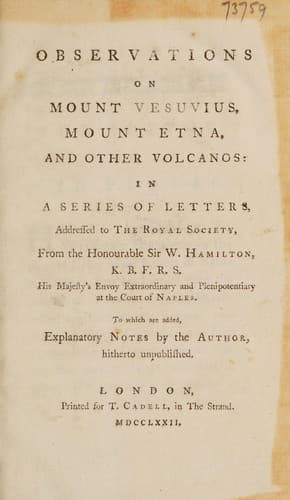
Observations on Mount Vesuvius, Mount Etna, and Other VolcanosHamilton, William, Sir
Science
Observations on Mount Vesuvius, Mount Etna, and Other Volcanos
Hamilton, William, Sir
Etna, Mount (Italy) -- Early works to 1800; Vesuvius (Italy) -- Early works to 1800; Volcanoes -- Italy -- Early works to 1800
Since I had the pleasure of sending you my letter, in which the nature
of the soil of more than twenty miles round this capital is described;
examining a deep hollow way cut by the rain waters into the outside cone
of the Solfaterra, I discovered, that a great part of the cone of that
ancient Volcano has been calcined by the hot vapours above described.
Pumice calcined seems to be the chief ingredient, of which several
specimens of (as I suppose) variegated unformed marble are composed, and
the beautiful variegations in them may have probably been occasioned by
the mineral vapours. As these specimens are now sent to the Royal
Society, you will see that these variegations are exactly of the same
pattern and colours as are met in many marbles and flowered alabasters;
and I cannot help thinking that they are marble or alabaster in its
infant state. What a proof we have here of the great changes the earth
we inhabit is subject to! What is now the Solfaterra, we have every
reason to suppose to have been originally thrown up by a subterraneous
explosion from the bottom of the sea. That it was long an existing
Volcano, is plain, from the ancient currents of lava, that are still to
be traced from its crater to the sea, from the strata of pumice and
erupted matter, of which its cone, in common with those of other
Volcanos, is composed, and from the testimony of many ancient authors.
Its cone in many parts has been calcined, and is still calcining, by the
hot vapours that are continually issuing forth through its pores; and
its nature is totally changed by this chemical process of Nature. In the
hollow way, where I made these remarks, you see the different strata of
erupted matter, that compose the cone, in some places perfectly
calcined, in others not, according as the vapours have found means to
insinuate themselves more or less.
A hollow way, cut by the rains on the back of the mountain on which part
of Naples is situated, towards Capo di China, shews that the mountain is
composed of strata of erupted matter, among which are large masses of
bitumen, in which its former state of fluidity is very visible. Here it
was I discovered that pumice stone is produced from bitumen, which I
believe has not yet been remarked. Some specimens shew evidently the
gradual process from bitumen to pumice: and you will observe that the
crystalline vitrifications, which are visible in the bitumen, suffer no
alteration, but remain in the same state in the perfect pumice as in the
bitumen.
Public-domain text, read in full here on John Shaqi.
Reviews
Reviews
No reviews yet
Be the first to share your thoughts on this work.
Join the Discussion
Join the discussion
Sign in to leave a comment or review.
Sign InorCreate an account