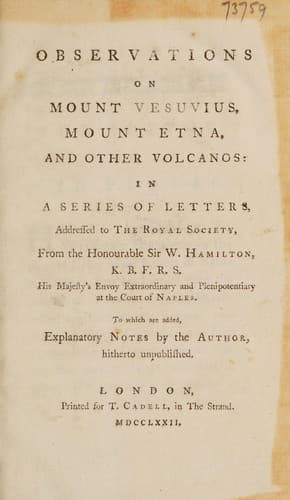
Observations on Mount Vesuvius, Mount Etna, and Other VolcanosHamilton, William, Sir
Science
Observations on Mount Vesuvius, Mount Etna, and Other Volcanos
Hamilton, William, Sir
Etna, Mount (Italy) -- Early works to 1800; Vesuvius (Italy) -- Early works to 1800; Volcanoes -- Italy -- Early works to 1800
In a piece of stratum, calcined from the outside of the Solfaterra, the
form and texture of the pumice stones is very discernible. In several
parts of the outside cone, this calcining operation is still carried on,
by the exhalation of constant very hot and damp vapours, impregnated
with salts, sulphur, alum, &c. Where the abovementioned vapours have not
operated, the strata of pumice and erupted matter, that compose the cone
of the Solfaterra, are like those of all the high grounds in its
neighbourhood, which I suppose to have been thrown up likewise by
explosion. I have seen here, half of a large piece of lava perfectly
calcined, whilst the other half out of the reach of the vapours has
been untouched; and in some pieces the centre seems to be already
converted into true marble.
The variegated specimens then, above described, are nothing more than
pumice and erupted matter, after having been acted upon in this manner
by the hot vapours; and if you consider the process, as I have traced
it, from bitumen to pumice, and from pumice to marble, you will think
with me, that it is difficult to determine the primitive state of the
many wonderful productions we see in Nature.
I found, in the _tufa_ of the mountain of Pausilipo, a fragment of lava:
one side I polished, to shew it to be true lava; the other shews the
signs of the _tufa_, with which it is incorporated. It has evidently
been rounded by friction, and most probably by rolling in the sea. Is it
not natural then to imagine that there must have been Volcanos near this
spot, long before the formation of the mountain of Pausilipo? This
little stone may perhaps raise in your mind such reflections as it did
in mine, relative to the great changes our globe suffers, and the
probability of its great antiquity.
FOOTNOTES:
[1] Having reflected since upon this circumstance, I rather believe that
the weight of the atmosphere in bad weather, preventing the free
dissipation of the smoke, and collecting it over the crater, gives it
the appearance of being more considerable; whereas in fine weather the
smoke is dispersed soon after its emission. It is, however, the
common-received opinion at Naples (and from my own observation is, I
believe, well founded), that when Vesuvius grumbles, bad weather is at
hand. The sea of the Bay of Naples, being particularly agitated, and
swelling some hours before the arrival of a storm, may very probably
force itself into crevices, leading to the bowels of the Volcano, and,
by causing a new fermentation, produce those explosions and grumblings.
[2] These ashes destroy the leaves and fruit, and are greatly
detrimental to vegetation for a year or two; but are certainly of great
service to the land in general, and are among the principal causes of
that very great fertility which is remarkable in the neighbourhood of
Volcano's.
Public-domain text, read in full here on John Shaqi.
Reviews
Reviews
No reviews yet
Be the first to share your thoughts on this work.
Join the Discussion
Join the discussion
Sign in to leave a comment or review.
Sign InorCreate an account