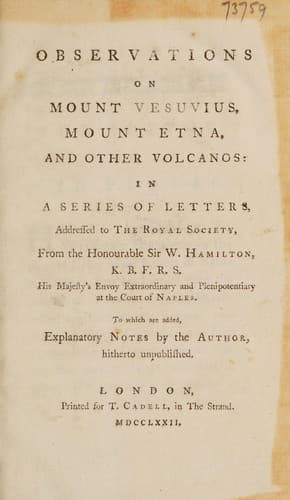
Observations on Mount Vesuvius, Mount Etna, and Other VolcanosHamilton, William, Sir
Science
Observations on Mount Vesuvius, Mount Etna, and Other Volcanos
Hamilton, William, Sir
Etna, Mount (Italy) -- Early works to 1800; Vesuvius (Italy) -- Early works to 1800; Volcanoes -- Italy -- Early works to 1800
[3] In the subsequent eruptions of Vesuvius, I have constantly remarked
something of the same nature, as appears in my account of the great
eruption of 1767. I have found the same remark in many accounts of
former eruptions of Vesuvius: in the very curious one of the formation
of a new mountain near Puzzole, in 1538, (as may be seen in my letter to
Dr. Maty, Oct. 16, 1770[46],) the same observation is made. This
phaenomenon, is well worthy of a curious inquiry, which might give some
light into the theory of the earth, of which, I believe, we are very
ignorant.
[4] I am convinced, that it might be very practicable to divert the
course of a lava when in this state, by preparing a new bed for it, as
is practised with rivers. I was mentioning this idea at Catania in
Sicily, when I was assured, that it had been done with success during
the great eruption of Etna, in 1669; that the lava was directing its
course towards the walls of Catania, and advancing slowly like the
abovementioned, when they prepared a channel for it round the walls of
the town, and turned it into the sea; that a succession of men, covered
with sheep-skins wetted, were employed to cut through the tough flanks
of the lava, till they made a passage for that in the centre (which was
in perfect fusion) to disgorge itself into the channel prepared for it.
A book I have since met with gives the same account of this curious
operation; it is intituled, _Relatione del nuovo incendio fatto da
Mongibello 1669. Messina, Giuseppe Bisagni, 1670_. His Sicilian
Majesty's palace at Portici, and the valuable collection of antiquities
that have been recovered from beneath the destructive lava's of
Vesuvius, are in imminent danger of being overwhelmed again by the next
that shall take its course that way; whereas, by taking a level, cutting
away and raising ground, as occasion might require, the palace and
museum would, in all probability, be insured, at least against one
eruption; and, indeed, I once took the liberty of communicating this
idea to the King of Naples, who seemed to approve of it.
[5] The late Lord Morton was pleased to give these specimens to Dr.
Morris, who has made several chemical experiments on them, the result of
which will be communicated to the Royal Society.
Public-domain text, read in full here on John Shaqi.
Reviews
Reviews
No reviews yet
Be the first to share your thoughts on this work.
Join the Discussion
Join the discussion
Sign in to leave a comment or review.
Sign InorCreate an account