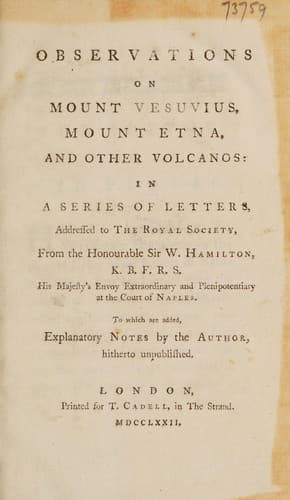
Observations on Mount Vesuvius, Mount Etna, and Other VolcanosHamilton, William, Sir
Science
Observations on Mount Vesuvius, Mount Etna, and Other Volcanos
Hamilton, William, Sir
Etna, Mount (Italy) -- Early works to 1800; Vesuvius (Italy) -- Early works to 1800; Volcanoes -- Italy -- Early works to 1800
[6] From what I have seen and read of eruptions of Vesuvius and Etna, I
am convinced that Volcano's lie dormant for several years, nay even for
centuries, as probably was the case of Vesuvius before its eruption in
the reign of Titus, and certainly was so before that of the year 1631.
When I arrived at Naples in 1764, Vesuvius was quiet, very seldom smoak
was visible on its top; in the year 1766, it seemed to take fire, and
has never since been three months without either throwing up red hot
stones, or disgorging streams of lava, nor has its crater been ever free
from smoak. At Naples, when a lava appears, and not till then, it is
styled an eruption; whereas I look upon the five nominal eruptions I
have been witness to, from March 1766 to May 1771, as, in effect, but
one continued eruption.
[7] It is certain, that, by constant attention to the smoak that issues
from the crater, a very good guess may be given as to the degree of
fermentation within the Volcano. By this alone I foretold[47] the two
last eruptions, and, by another very simple observation, I pointed out,
some time before, the very spot from whence the lava has issued. When
the cone of Vesuvius was covered with snow, I had remarked a spot on
which it would not lie: concluding very naturally that this was the
weakest part of the cone, and that the heat from within prevented the
snow from lying; it was as natural to imagine that the lava, seeking a
vent, would force this passage sooner than another; and so indeed it
came to pass.
[8] These are his words: "Nubes (incertum procul intuentibus ex quo
monte Vesuvium fuisse postea cognitum est) oriebatur, cujus
similitudinem & formam, non alia magis arbor, quam pinus expresserit.
Nam longissimo veluti trunco elata in altum, quibusdam ramis
diffundebatur, credo quia recenti spiritu evecta, dein senescente eo
destituta, aut etiam pondere suo victa, in latitudinem evanescebat:
candida interdum, interdum sordida & maculosa, prout terram cineremve
sustulerat." Plin. lib. vi. ep. 16.
[9] The windows at Naples open like folding-doors.
Public-domain text, read in full here on John Shaqi.
Reviews
Reviews
No reviews yet
Be the first to share your thoughts on this work.
Join the Discussion
Join the discussion
Sign in to leave a comment or review.
Sign InorCreate an account