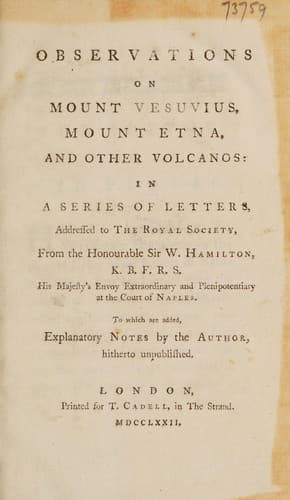
Observations on Mount Vesuvius, Mount Etna, and Other VolcanosHamilton, William, Sir
Science
Observations on Mount Vesuvius, Mount Etna, and Other Volcanos
Hamilton, William, Sir
Etna, Mount (Italy) -- Early works to 1800; Vesuvius (Italy) -- Early works to 1800; Volcanoes -- Italy -- Early works to 1800
[10] In several accounts of former eruptions of Vesuvius, I have found
mention of the ashes falling at a much greater distance; that, in the
year 472 and 473, they had reached Constantinople: Dio says, that during
the eruption of Vesuvius in the time of Titus--"tantus fuit pulvis ut ab
eo loco in Africam et Syriam et AEgyptum penetraverit." A book printed at
Lecce, in the kingdom of Naples, in MDCXXXII, and intituled, _Discorso
sopra l'origine de fuochi gettati dal Monte Vesuvio di Gio Francesco
Sorrata Spinola Galateo_, says, that the 16th of December, 1631, the
very day of the great eruption of Vesuvius (though perfectly calm), it
rained ashes at Lecce, which is nine days journey from the mountain:
that the day was darkened by them, and that they covered the ground
three inches deep; that ashes of a different quality fell at Bari the
same day; and that at both these places the inhabitants were very
greatly alarmed, not being able to conceive the occasion of such a
phaenomenon. Antonio Bulifon, in his account of the same eruption, says,
that the ashes fell, and lay several inches deep at Ariano in Puglia;
and I have been assured, by many persons of credit at Naples, that they
have been sensible of the fall of ashes, during an eruption, at above
two hundred miles distance from Vesuvius. The Abbate Giulio Cesare
Bracini, in his account of the eruption of Vesuvius, in 1631, says, that
the height of the column of smoak and ashes, taken from Naples by a
quadrant, was upwards of thirty miles. Though such uncertain
calculations demand but little attention; yet, by what I have seen, I am
convinced, that in great eruptions the ashes are sent up to so great a
height as to meet with extraordinary currents of air, which is the most
probable way of accounting for their having been carried to so great a
distance in a few hours. In a book, intituled, _Salvatoris Varonis
Vesuviani incendii Libri tres: Neapoli_, MDCXXXIV, I found a very
poetical description of the ashes that lay in the neighbourhood of
Vesuvius, after the eruption of 1631, in depth, from twenty to a hundred
palms: "Quare," says this author, "multi patrio in solo requirunt
patriam, et vix ibi se credunt vivere ubi certo sciant sese natos, adeo
totam loci speciem tempestas vertit."
[11] This conjecture has proved true; for, even in the month of April
1771, I again thrust sticks into some crevices of this lava, and they
immediately took fire. On Mount Etna, in 1769, I observed the lava, that
had been disgorged in 1766, smoak in many parts.
Public-domain text, read in full here on John Shaqi.
Reviews
Reviews
No reviews yet
Be the first to share your thoughts on this work.
Elsewhere in the archive
Join the Discussion
Join the discussion
Sign in to leave a comment or review.
Sign InorCreate an account