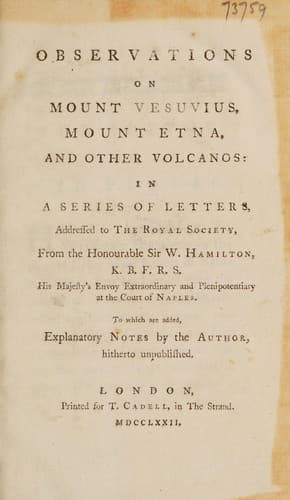
Observations on Mount Vesuvius, Mount Etna, and Other VolcanosHamilton, William, Sir
Science
Observations on Mount Vesuvius, Mount Etna, and Other Volcanos
Hamilton, William, Sir
Etna, Mount (Italy) -- Early works to 1800; Vesuvius (Italy) -- Early works to 1800; Volcanoes -- Italy -- Early works to 1800
[12] In all accounts of great eruptions of Mount Etna and Mount
Vesuvius, I have found mention of this sort of lightning. Pliny the
younger, in his second letter to Tacitus upon the eruption of Vesuvius
in the time of Titus, says, that a black and horrible cloud covered them
at Misenum (which is above fifteen miles from the Volcano), and that
flashes of zig-zag fire, like lightning, but stronger, burst from it;
these are his words: "ab altero latere nubes atra et horrenda ignei
spiritus tortis vibratisque discursibus rupta, in longas flammarum
figuras dehiscebat; fulgoribus illae et similes et majores erant." This
was evidently the same electrical fire, and with which I am convinced
that the smoak of all Volcanos is pregnant. In several accounts of the
great eruption of Vesuvius in 1631, mention is made of damage done by
the lightning that issued from the column of smoak. Bulifon, in
particular, says, that, in the neighbourhood of the Volcano, people were
struck dead in the same manner as if by lightning, without having their
cloaths singed. Pliny mentions a like instance, which shews that the
ancients had observed this phaenomenon; for he says, that at Pompeii, the
day being fair, Marcus Herennius was struck dead by lightning. These are
his words; "In Catilianis prodigiis, Pompeiano ex municipio M. Herennius
Decurio _serena die_, fulmine ictus est." Plin. Hist. Nat. lib. II. cap.
LI. The learned and ingenious Father Beccaria, at Turin, assured me,
that he had been greatly pleased with my observations on this species of
lightning, as coinciding perfectly with several of his electrical
experiments.
[13] "I am well convinced, by this collection, that many variegated
marbles, and many precious stones, are the produce of Volcanos; and that
there have been Volcanos in many parts of the world, where at present
there are no traces of them visible." This is taken from a prior letter
to Lord Morton, dated April 7, 1767.
[14] In some accounts of an eruption of Vesuvius in 1660, I find mention
made of ashes which fell in the shape of crosses, and were looked upon
as highly miraculous; but in one book upon this subject, intituled,
_Athanasii Kircheri Soc. Jes. De prodigiosis crucibus, &c. Romae_,
MDCLXI, a very philosophical account is given of this phaenomenon; he
says, that, in 1660, from the 16th of August to the 15th of October,
Vesuvius cast up ashes, impregnated with nitrous, saline, and bituminous
sulphur, which upon linen garments took the form of crosses, probably
directed by the cross-threads in the linen, and therefore that the salts
did not shoot into such a shape when they fell upon garments of woollen;
a very particular description of these crosses may be found in page 38,
of the abovementioned book.
Public-domain text, read in full here on John Shaqi.
Reviews
Reviews
No reviews yet
Be the first to share your thoughts on this work.
Elsewhere in the archive
Join the Discussion
Join the discussion
Sign in to leave a comment or review.
Sign InorCreate an account