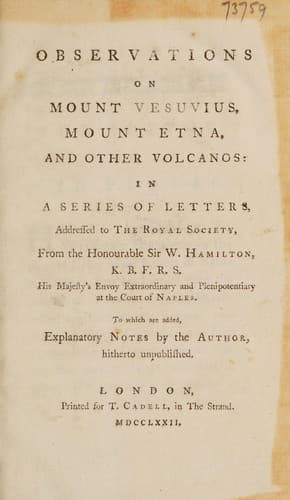
Observations on Mount Vesuvius, Mount Etna, and Other VolcanosHamilton, William, Sir
Science
Observations on Mount Vesuvius, Mount Etna, and Other Volcanos
Hamilton, William, Sir
Etna, Mount (Italy) -- Early works to 1800; Vesuvius (Italy) -- Early works to 1800; Volcanoes -- Italy -- Early works to 1800
[15] I have since found in this stratum of erupted matter at Pompeii,
stones weighing eight pounds: but many accounts of the great eruption of
Vesuvius, particularly that of Antonio Bulifon, mention that a stone
like a bomb was thrown from the crater of Vesuvius in 1631; and fell
upon the Marquis of Lauro's house at Nola, which it set on fire. As Nola
is twelve miles from Vesuvius, this circumstance seems rather
extraordinary: however, I have seen stones of an enormous size shot up
to a very great height by Mount Vesuvius. In May 1771, having a stop
watch in my hand, I observed that one of these stones was eleven seconds
falling from its greatest height, into the crater from whence it had
been ejected. In 1767, a solid stone, measuring twelve feet in height,
and forty-five in circumference, was thrown a quarter of a mile from the
crater; the eruption of 1767, though by much the most violent of this
century, was, comparatively to those of the year 79 and 1631, very mild.
[16] See Letter V. in this collection.
[17] It is the common received opinion, that this mountain rose from the
bottom of the Lucrine lake. I had not seen the very curious and
particular account of its formation (which account is in my next letter)
when I wrote this, and was therefore in the same error.
[18] This must depend greatly upon the quality of the lava's; some have
been in a more perfect state of vitrification than others, and are
consequently less liable to the impressions of time. I have often
observed on Mount Vesuvius, when I have been close to the mouth from
whence a lava was disgorging itself, that the quality of it varied
greatly from time to time: I have seen it as fluid and coherent as glass
when in fusion: and I have seen it farinacious, the particles separating
as they forced their way out, just like meal coming from under the
grindstones. A stream of lava of this sort, being less compact, and
continuing more earthy particles, would certainly be much sooner fit for
vegetation, than one composed of the more perfect vitrified matter.
[19] This earthquake happened in the year 1693, and destroyed forty-nine
towns and villages, nine hundred and twenty-two churches, colleges, and
convents; and near one hundred thousand persons were buried in their
ruin.
[20] It is intituled, "A true and exact relation of the late prodigious
earthquake and eruption of Mount AEtna, or Monte Gibello; as it came in a
letter written to his Majesty from Naples, by the Right Honourable the
Earl of Winchelsea, his Majesty's late Embassador at Constantinople,
who, in his return from thence, visiting Catania in the island of
Sicily, was an eye-witness of that dreadful spectacle; together with a
more particular narrative of the same, as it is collected out of the
several relations sent from Catania; published by authority. Printed by
T. Newcomb, in the Savoy, 1669."
Public-domain text, read in full here on John Shaqi.
Reviews
Reviews
No reviews yet
Be the first to share your thoughts on this work.
Elsewhere in the archive
Join the Discussion
Join the discussion
Sign in to leave a comment or review.
Sign InorCreate an account