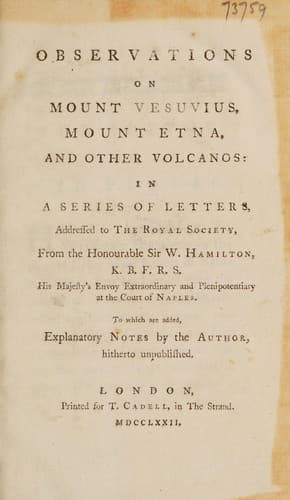
Observations on Mount Vesuvius, Mount Etna, and Other VolcanosHamilton, William, Sir
Science
Observations on Mount Vesuvius, Mount Etna, and Other Volcanos
Hamilton, William, Sir
Etna, Mount (Italy) -- Early works to 1800; Vesuvius (Italy) -- Early works to 1800; Volcanoes -- Italy -- Early works to 1800
"I accepted, says the author, p. 38, the invitation of the Bishop of
Catania, to stay a day with him, that so I might be the better able to
inform your Majesty of that extraordinary fire, which comes from Mount
Gibel, fifteen miles distant from that city, which, for its horridness
in the aspect, for the vast quantity thereof (for it is fifteen miles in
length, and seven in breadth), for its monstrous devastation and quick
progress, may be termed an inundation of fire, a flood of fire, cinders,
and burning stones, burning with that rage as to advance into the sea
six hundred yards, and that to a mile in breadth, which I saw; and that
which did augment my admiration was, to see in the sea this matter like
ragged rocks, burning in four fathom water, two fathom higher than the
sea itself, some parts liquid, and throwing off, not with great
violence, the stones about it, which, like a crust of a vast bigness,
and red hot, fell into the sea every moment, in some place or other,
causing a great and horrible noise, smoak, and hissing in the sea; and
that more and more coming after it, making a firm foundation in the sea
itself. I stayed there from nine a clock on Saturday morning, to seven
next morning;" (this must have been towards the middle or latter end of
April;) "and this mountain of fire and stones with cinders had advanced
into the sea twenty yards at least, in several places; in the middle of
this fire, which burnt in the sea, it hath formed like to a river, with
its banks on each side very steep and craggy; and in this channel moves
the greatest quantity of this fire, which is the most liquid, with
stones of the same composition, and cinders all red hot, swimming upon
the fire of a great magnitude; from this a river of fire doth proceed
under the great mass of the stones, which are generally three fathoms
high all over the country, where it burns, and in other places much
more. There are secret conduits or rivulets of the liquid matter, which
communicates fire and heat into all parts more or less, and melts the
stones and cinders by fits in those places where it toucheth them, over
and over again; where it meets with rocks or houses of the same matter
(as many are), they melt and go away with the fire; where they find
other compositions, they turn them to lime or ashes (as I am informed).
The composition of this fire, stones, and cinders, are sulphur, nitre,
quicksilver, sal ammoniac, lead, iron, brass, and all other metals. It
moves not regularly, nor constantly down hill[48]; in some places it
hath made the vallies hills, and the hills that are not high are now
vallies. When it was night, I went upon two towers, in divers places;
and could plainly see at ten miles distance, as we judged, the fire to
begin to run from the mountain in a direct line, the flame to ascend as
high and as big as one of the greatest steeples in your Majesty's
kingdoms, and to throw up great stones into the air; I could discern the
Public-domain text, read in full here on John Shaqi.
Reviews
Reviews
No reviews yet
Be the first to share your thoughts on this work.
Elsewhere in the archive
Join the Discussion
Join the discussion
Sign in to leave a comment or review.
Sign InorCreate an account