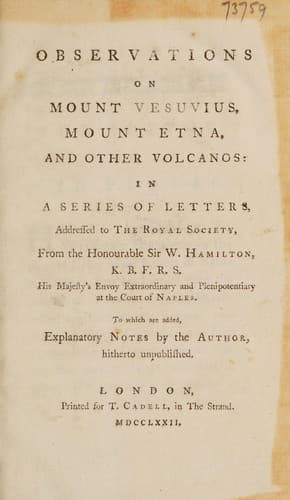
Observations on Mount Vesuvius, Mount Etna, and Other VolcanosHamilton, William, Sir
Science
Observations on Mount Vesuvius, Mount Etna, and Other Volcanos
Hamilton, William, Sir
Etna, Mount (Italy) -- Early works to 1800; Vesuvius (Italy) -- Early works to 1800; Volcanoes -- Italy -- Early works to 1800
river of fire to descend the mountain of a terrible fiery or red colour,
and stones of a paler red to swim thereon, and to be some as big as an
ordinary table. We could see this fire to move in several other places,
and all the country covered with fire, ascending with great flames[49],
in many places, smoaking like to a violent furnace of iron melted,
making a noise with the great pieces that fell, especially those which
fell into the sea. A Cavalier of Malta, who lives there, and attended
me, told me, that the river was as liquid where it issues out of the
mountain, as water, and came out like a torrent with great violence, and
is five or six fathom deep, and as broad, and that no stones sink
therein. I assure your Majesty, no pen can express how terrible it is,
nor can all the art and industry of the world quench or divert that
which is burning in the country. In forty days time, it hath destroyed
the habitations of 27,000 persons; made two hills of one, 1000 paces
high apiece, and one is four miles in compass; of 20,000 persons, which
inhabit Catania, 3000 did only remain; all their goods are carried away,
the cannons of brass are removed out of the castle, some great bells
taken down, the city-gates walled up next the fire, and preparations
made to abandon the city.
"That night which I lay there, it rained ashes all over the city, and
ten miles at sea it troubled my eyes. This fire in its progress met with
a lake of four miles in compass; and it was not only satisfied to fill
it up, though it was four fathom deep, but hath made of it a mountain."
[21] I have heard since, from some of our countrymen who have measured
this tree, that its dimensions are actually as abovementioned, but that
they could perceive some signs of four stems having grown together, and
formed one tree.
[22] No great stress should be laid upon these observations, as the many
inconveniences we laboured under, and the little practice we had in such
nice operations, must necessarily have rendered them very inaccurate.
The Canon Recupero, who was our guide, attended Mess. Glover, Fullerton,
and Brydone, up Mount Etna in June 1770. The latter is a very ingenious
and accurate observer, and has taken the height of many of the highest
mountains in the Alps. His observations, as the Canon informed me, were
as follows: At the top of the mountain the quicksilver in the
thermometer was 9 degrees below freezing point, when at the foot of the
mountain it rose to 76. At the foot of the little mountain that crowns
the Volcano the barometer stood at 20 deg. 4-2/3', half way up this little
mountain it was at 19 deg. 6'; but the wind was too violent for them to
attempt any more observations. The barometer and thermometer were of
Fahrenheit's. Mr. Brydone remarked, as he went up in the night, that he
could distinguish the stars in the milky way with wonderful clearness,
and that the cold was much more intense than he had ever felt upon the
highest mountains of the Alps.
Public-domain text, read in full here on John Shaqi.
Reviews
Reviews
No reviews yet
Be the first to share your thoughts on this work.
Elsewhere in the archive
Join the Discussion
Join the discussion
Sign in to leave a comment or review.
Sign InorCreate an account