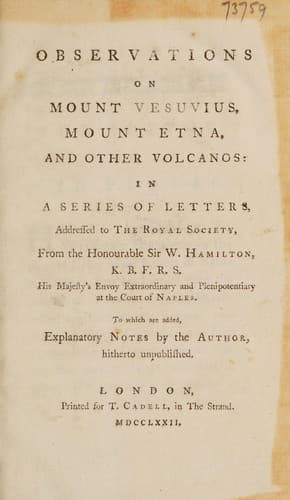
Observations on Mount Vesuvius, Mount Etna, and Other VolcanosHamilton, William, Sir
Science
Observations on Mount Vesuvius, Mount Etna, and Other Volcanos
Hamilton, William, Sir
Etna, Mount (Italy) -- Early works to 1800; Vesuvius (Italy) -- Early works to 1800; Volcanoes -- Italy -- Early works to 1800
[40] The noxious vapours which Lucan mentions to have prevailed at
Nisida, favour my opinion as to its origin:
"--Tali spiramine Nesis
"Emittit stygium nebulosis aera saxis."
Lucan. lib. vi.
[41] Giulio Cesare Capaccio, in his account of this island, says, that
there are eleven springs of cold water, and thirty-five of hot and
mineral waters.
[42] By having remarked, that all the implements of stone brought by
Mess. Banks and Solander from the new-discovered islands in the
South-Seas, are evidently of such a nature as are only produced by
Volcanos; and as these gentlemen have assured me, that no other kind of
stone is to be met with in the islands; I am induced to think, that
these islands (at so great a distance from any continent) may have
likewise been pushed up from the bottom of the sea by like explosions.
[43] Any one, the least conversant in Volcanos, must be struck with the
numberless evident marks of them the whole road from the lake of Albano
to Radicofani, between Naples and Florence; and yet, though this soil
bears such fresh and undoubted marks of its origin, no history reaches
the date of any one eruption in these parts.
[44] May not the air in countries replete with sulphur be more
impregnated with electrical matter than the air of other soils? and may
not the sort of lightning, which is mentioned by several ancient authors
to have fallen in a serene day, and was considered as an omen, have
proceeded from such a cause?
Horace says, Ode xxxiv.
"--Namque Diespeter
"Igni corusco nubila dividens
"Plerumque per purum tonantes
"Egit equos volucremque currum."
"Non alias coelo ceciderunt plura sereno
"Fulgura----"
Virgil. Georgic. i.
"Aut cum terribili perculsus fulmine civis
"Luce serenanti vitalia lumina liquit."
Cic. i. de Divin. n. 18.
"--Sabinos petit aliquanto tristior, quod sacrificanti hostia
aufugerat: quodque tempestate serena tonuerat."
Sueton. _Tit._ cap. 10.
[45] This letter was not received by Dr. Maty in its present form: and
is rather the substance of an explanatory catalogue, which was sent to
that gentleman with sundry specimens of the different materials that
compose the soil described in the preceding letter; which catalogue
remains, with the specimens, in the Museum of the Royal Society, for the
inspection, and, I flatter myself, the satisfaction, of the curious in
natural history.
[46] See p. 103 of this collection.
[47] See Letter I. p. 18.
Public-domain text, read in full here on John Shaqi.
Reviews
Reviews
No reviews yet
Be the first to share your thoughts on this work.
Elsewhere in the archive
Join the Discussion
Join the discussion
Sign in to leave a comment or review.
Sign InorCreate an account