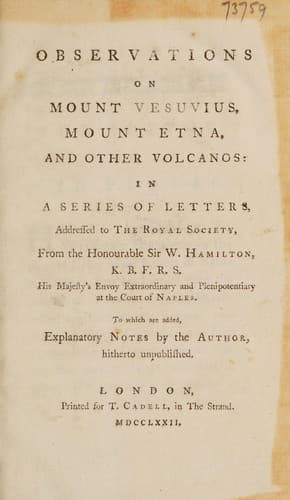
Observations on Mount Vesuvius, Mount Etna, and Other VolcanosHamilton, William, Sir
Science
Observations on Mount Vesuvius, Mount Etna, and Other Volcanos
Hamilton, William, Sir
Etna, Mount (Italy) -- Early works to 1800; Vesuvius (Italy) -- Early works to 1800; Volcanoes -- Italy -- Early works to 1800
[33] Strabo, in his fifth book of Geography, says, "Supra haec loca situs
est Vesuvius mons agris cinctus optimis: dempto vertice, qui magna sui
parte planus, totus sterilis est, adspectu cinaereus, cavernasque
ostendens fistularum plenas et lapidum colore fuliginoso, utpote ab igni
exesorum, ut conjecturam facere possit ista loca quondam arsisse, et
crateras ignis habuisse, deinde materia deficiente restincta fuisse."
Diodorus Siculus, in his fourth book, describing the voyage of Hercules
into Italy, says, "Phlegraeus quoque campus is locus appellatur a colle
nimirum, qui AEtnae instar Siculae magnam vim ignis eructabat; nunc
Vesuvius nominatur, multa inflammationis pristinae vestigia reservans."
And Vitruvius, in the sixth chapter of the second book, says, "Non minus
etiam memoratur antiquitus crevisse ardores et abundasse sub Vesuvio
monte et inde evomuisse circa agros flammas." Tacitus, mentioning the
eruption of Vesuvius in the reign of Titus, seems to hint likewise at
former eruptions, in these words: "Jam vero novis cladibus, vel post
longam saeculorum repetitis afflictae, haustae aut abrutae fecundissima
Campaniae ora et urbs incendiis vastata."
[34] Bracini, in his account of the eruption of 1613, says, that he
found many sorts of sea shells on Vesuvius after that eruption; and P.
Ignatio, in his account of the same eruption, says, that he and his
companions picked up many shells likewise at that time upon the
mountain: this circumstance would induce one to believe, that the water
thrown out of Vesuvius, during that formidable eruption, came from the
sea.
[35] In book xi. c. 93. he observes, that about Sinuessa and Puteoli,
"Spiracula vocant--alii Caroneas scrobes, mortiferum spiritum
exhalantes." And Seneca, Nat. Quaest. lib. vi. cap. 28. "Pluribus Italiae
locis per quaedam foramina pestilens exhalatur vapor, quem non homini
ducere, non ferae tutum est. Aves quoque si in illum inciderint, antequam
coelo meliore leniatur, in ipso volatu cadunt, liventque corpora, et non
aliter quam per vim elisae fauces tument."
[36] I have remarked, that, after a great fall of rain, the degree of
heat in this water is much less, which will account for what the Padre
Torre says (in his book, entituled, _Histoire et Phenomenes du Vesuve_),
that, when he tried it in company with Monsieur de la Condamine, the
degree of heat, upon Reaumur's thermometer, was 68 deg.
[37] This very scarce volume has been presented by Sir William Hamilton
to the British Museum. M. M.
[38] Here again we have an example of the electrical fire attending a
great eruption.
[39] The cup, or crater, on the top of the new mountain is now covered
with shrubs; but I discovered at the bottom of it, in the year 1770,
amidst the bushes, a small hole, which exhales a constant hot and damp
vapour, just such as proceeds from boiling water, and with as little
smell; the drops of this steam hang upon the neighbouring bushes.
Public-domain text, read in full here on John Shaqi.
Reviews
Reviews
No reviews yet
Be the first to share your thoughts on this work.
Elsewhere in the archive
Join the Discussion
Join the discussion
Sign in to leave a comment or review.
Sign InorCreate an account