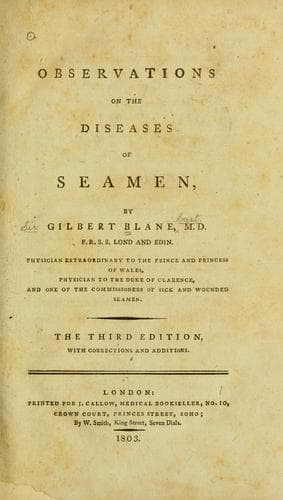
Observations on the Diseases of SeamenBlane, Gilbert, Sir
History
Observations on the Diseases of Seamen
Blane, Gilbert, Sir
Medicine, Naval -- Early Works To 1800; Sailors -- Diseases
But when water is offensive in consequence of being long kept, the most
effectual and expeditious method of sweetening it is by exposing it
to the air in as divided a state as possible. Boiling will not expel
the putrid effluvia contained in water; but such is the attraction of
air for this offensive matter, that the water need only be thoroughly
exposed to it to be rendered quite sweet. This is best done by a
machine invented by Mr. Osbridge, a lieutenant of the navy. It consists
of a hand pump, which is inserted in a scuttle made at the top of a
cask, and by means of it the water, being raised a few feet, falls
through several sheets of tin pierced like cullenders, and placed
horizontally in a half cylinder of the same metal. The purpose of it is
to reduce the water into numberless drops, which being exposed in this
form to the open air, is deprived of its offensive quality. The same
method will serve to separate the superfluous quick lime in the water.
It is a machine very deservedly in common use, and the working of it is
a moderate and salutary exercise to men in fair weather.
The following contrivance will be found to afford a sufficient supply
of sweet water to particular messes, and may be considered as an
artificial and more expeditious sort of dripping stone.--Let the
narrow mouth of a large funnel be filled with a bit of sponge, over
which let there be a layer of clean gravel or sand covered with a
piece of flannel, and over the whole another layer of sand. Muddy or
offensive water being poured upon this, runs or drops out clear; and
care must be taken to change the sand, sponge, &c. frequently, as they
will become loaded with the impurities of the water[81].
There should be in every ship an apparatus for distilling water in
case of distress. This consists merely of a head and worm adapted to
the common boiler, and distillation may go on while the victuals are
boiling. More than eight gallons of excellent fresh water may be drawn
off in an hour from the copper of the smallest ship of war[82]. I refer
for a more particular account of all this to the works of Dr. Lind,
who was the original inventor and recommender of this method.
This invention seems to have escaped others so long, from the idea that
the _desideratum_ in freshening sea water was some substance to be
added to it while under distillation. No such substance is necessary,
and, the more simple the mode of distillation, the fresher the water
will prove.
Rain water at sea is always pure and wholesome, and may be saved
occasionally by means of a sail or awning.
CHAP. III.
Of CLOTHING.
Public-domain text, read in full here on John Shaqi.
Reviews
Reviews
No reviews yet
Be the first to share your thoughts on this work.
Elsewhere in the archive
Join the Discussion
Join the discussion
Sign in to leave a comment or review.
Sign InorCreate an account