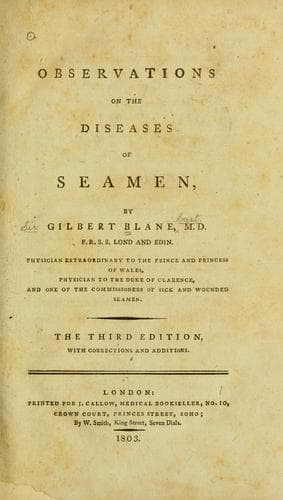
Observations on the Diseases of SeamenBlane, Gilbert, Sir
History
Observations on the Diseases of Seamen
Blane, Gilbert, Sir
Medicine, Naval -- Early Works To 1800; Sailors -- Diseases
Delirium is a symptom, to the nature and appearances of which I have
been particularly attentive, in consequence of a painful and diligent
attendance upon some cases in which I was particularly interested from
friendship and affection, and in which this was a remarkable symptom.
It seems chiefly to consist in a false reference of our sensations,
whether external or internal; and this is in no sort of fever more
evident than in this. When any painful impression, for instance, is
made by an external body, the patient, if in a state of delirium, does
not refer it justly to the part affected; but the general agitation and
incoherence of sentiments will be aggravated for the time. I have known
a degree of heat applied to the extremities sufficient to blister them,
yet the part did not shrink, though the raving and general uneasiness
were increased. In like manner, with regard to internal sensations,
when an irritation is excited to expel the urine or _feces_, the mind
does not recognize it as such, but from a sense of uneasiness, probably
mistaken for something else, an effort is made to relieve nature,
which is done without a proper consciousness, and certain symptoms
are produced which are well-known marks of danger in this fever. In
watching those who have been under the influence of delirium, I have
observed it increase when any particular want of nature urged, and
this would continue for some time, the patient being incapable of
procuring himself immediate relief on account of the false reference
of sensation that has been mentioned; but he would become calm after
voiding the urine or _feces_, or after receiving something to drink,
according to the particular want that was present at the time. So
great is the disorder in the common course of sensation in this fever,
that a person ill of it has been even unconscious of inflammations of
vital parts, which, in the natural state of the nerves, would have
excited the most acute pain, and would have been distinctly referred
to the part affected, but were not discovered nor suspected till
inspection after death[89]. I remember one case in which there were
found large erosions, and even holes in the intestines, without any
preceding complaint that could have led to suspect such an appearance.
It would appear that the motions excited in the brain and nerves in
such cases, instead of producing the sensations naturally belonging to
them, serve to excite disagreeable emotions of a different kind, in
which delirium consists. It seems to be from the same depraved state
of sensation, that when a phthisical person is seized with this sort
of fever, his cough is for the time suspended. I have seen the same
circumstance occur in a maniacal case. From a like cause it sometimes
happens in dangerous cases of fever, that in the height of delirium the
_epiglottis_ loses its natural irritability, so that liquids in the
act of swallowing are apt to get into the windpipe, so as to excite
Public-domain text, read in full here on John Shaqi.
Reviews
Reviews
No reviews yet
Be the first to share your thoughts on this work.
Elsewhere in the archive
Join the Discussion
Join the discussion
Sign in to leave a comment or review.
Sign InorCreate an account