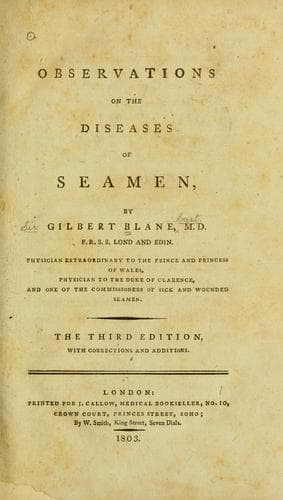
Observations on the Diseases of SeamenBlane, Gilbert, Sir
History
Observations on the Diseases of Seamen
Blane, Gilbert, Sir
Medicine, Naval -- Early Works To 1800; Sailors -- Diseases
The next step towards procuring a remission is, to open the pores
of the skin, which is best done by small doses of James’s powder or
emetic tartar, assisted by the common saline draughts, which will be
given with most advantage in the act of effervescence, or by _Spiritus
Mindereri,_ together with plentiful warm dilution. I once, by way of
comparison, tried the two antimonial preparations above mentioned in
a number of men ill of this fever, who were sent to the hospital at
one time, giving emetic tartar to one half, and James’s powder to the
other, and their effects were so similar, that I could perceive no
reason for preferring the one to the other. Antimonial medicines seem
better adapted to this than any other sort of fever, and may be more
freely given in it.
These are the most likely means of bringing about a remission; and if
this is effected, nothing remains to be done but to throw in as much
Peruvian bark as the stomach will bear.
But whether from a fresh accumulation of bile, or some other
circumstance, it may happen that the fever is kept up; and in this
case there is commonly a sense of weight or uneasiness about the
_hypochondria_, which seems to indicate that the redundant bile is in
the gall bladder or ducts of the liver. In this case a repetition of
evacuants is necessary, and calomel will be found to answer remarkably
well as a purgative, its stimulus being so extensive as to loosen
and bring away bile when the saline purgatives, such as that above
mentioned, had failed of having that effect. I have known these to
pass through the intestines without relieving the uneasy sensation
about the stomach as calomel is found to do; and it will be still more
effectual for this purpose, if given alone in a dose, from five to ten
grains, and followed some hours afterwards by some other purgative.
After this, antimonial medicines are again to be had recourse to; and
these, as well as purgative and neutral medicines, are safe and useful
in a more advanced stage of this fever than they are in the ship fever;
for the strength is not so apt to sink, and the state of the bowels
requires them more. Antimonials, however, are to be used sparingly and
cautiously as the fever advances; for I have known them, when given
only a few days after the first attack, to have the effect, in some
constitutions, of making the stomach swell, and of producing a general
sense of heat and uneasiness.
After the evacuations of the bowels, the anodyne diaphoretic may be
very seasonably given in the manner formerly mentioned; for it will not
only tend to sooth and procure sleep after the commotion that has been
excited, but by its gentle sudorific effect will assist in completing
the remission.
Public-domain text, read in full here on John Shaqi.
Reviews
Reviews
No reviews yet
Be the first to share your thoughts on this work.
Elsewhere in the archive
Join the Discussion
Join the discussion
Sign in to leave a comment or review.
Sign InorCreate an account