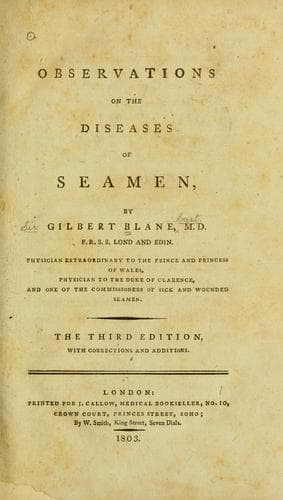
Observations on the Diseases of SeamenBlane, Gilbert, Sir
History
Observations on the Diseases of Seamen
Blane, Gilbert, Sir
Medicine, Naval -- Early Works To 1800; Sailors -- Diseases
The state which the great intestines fall into in old dysenteries
seems to have something in it peculiar to itself: the several coats
become thick and spongy; their texture is obliterated and destroyed;
and they become of a black or very dark purple colour. This, however,
cannot be called mortification; for the fibres of the gut do not lose
their tenacity, nor is there that putrid and dissolved state in which
gangrene consists; but it advances in time to such an extreme state
of disease as to be entirely incapable of recovering its natural
appearance and functions, and proves therefore the cause of death.
The greater frequency and obstinacy of these chronic fluxes in hot than
in cold climates seems to be owing to the same weakening of the powers
of life which make recovery in general so tedious, and particularly
that of wounds and ulcers. The greater quantity of acrid bile will also
tend to keep up the ulceration. Dysenteries have this disadvantage,
that the Peruvian bark, which is the most powerful restorative in other
complaints of this climate, is here found to be inadmissible on account
of the heat, thirst, and other febrile symptoms, which it seldom fails
to induce in all stages of this disease.
TREATMENT of FLUXES.
There are few diseases in which a prudent employment of art is more
useful, or in which early means of relief are more requisite than in
this[114].
Where the dysentery is the original disease, and when the patient is
robust and plethoric, with acute pain and a strong pulse, blood-letting
may be practised with advantage in the beginning of the complaint. But
there is no part of the practice in this disease in which the climate
and manner of life makes a greater difference than in this; for in a
temperate climate it frequently happens that repeated blood-letting is
necessary; but in a hot climate, where the fibres are relaxed, and in
the constitutions of seamen, whom we seldom or never find plethoric,
the inflammatory symptoms requiring this evacuation do not run so high,
nor continue so long.
It is in all cases of the utmost consequence to administer as early as
possible a brisk saline purgative. An ounce and a half or two ounces
of purging salts may be dissolved in a quart of barley water or water
gruel, and given warm in cupfuls, at small intervals, till a free
and copious evacuation is produced. If there should be much fever,
or sickness at stomach, two grains of emetic tartar will be a great
improvement of this medicine; and there will be this farther advantage
from its use, that if the stomach should be loaded with bile, in which
state it is more irritable, an evacuation upwards will also be excited
to the great relief of the patient.
Public-domain text, read in full here on John Shaqi.
Reviews
Reviews
No reviews yet
Be the first to share your thoughts on this work.
Elsewhere in the archive
Join the Discussion
Join the discussion
Sign in to leave a comment or review.
Sign InorCreate an account