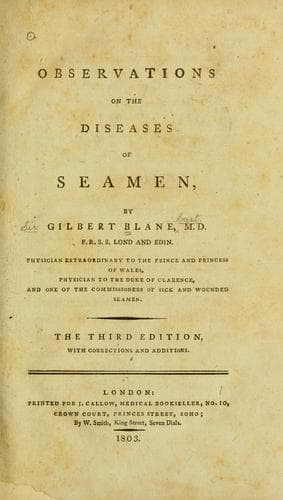
Observations on the Diseases of SeamenBlane, Gilbert, Sir
History
Observations on the Diseases of Seamen
Blane, Gilbert, Sir
Medicine, Naval -- Early Works To 1800; Sailors -- Diseases
This early and seasonable measure will, in many cases, put a stop
to the disease, especially if the patient is thrown into a sweat
immediately after the bowels have been thus thoroughly evacuated. It
is of great service in this disease to promote free perspiration, and
even a plentiful sweat, which may be effected with great advantage by
giving, at bed time, a medicine composed of opium, ipecacuana, and a
little neutral salt, accompanying it with plentiful warm dilution.
Nothing tends more to relieve griping and tenesmus than a general,
warm moisture on the skin. The ipecacuana, which is an ingredient in
this medicine, is one of the best anti-dysenteric remedies we know;
the opium procures rest; and this, joined to the sudorific effect of
the whole, not only gives a temporary relief, but tends to carry off
the disease. It is most properly given in the evening; for there would
be this inconvenience in constantly encouraging a sweat, that if the
tenesmus should return, it would either be checked by the patient
getting frequently out of bed, or there would be danger of his catching
cold. I am well aware that we cannot be too cautious with regard to the
use of opium in the beginning of this disease; but it is admissible
more early in a hot climate than a cold one, as the inflammatory
symptoms are less violent and can be sooner subdued; besides, it
becomes an entirely different medicine when conjoined with the other
ingredients that have been mentioned.
The best medicine in the day time we found to be small doses of
ipecacuana alone twice or thrice a day; and if there should be fresh
collections of bile, small doses of the saline purgative will be
necessary. Ipecacuana in this intention, may be given in the dose of
two grains in athletic constitutions, such as those of seamen; but
in the more delicate constitutions, such as are commonly met with in
private practice, one grain is a sufficient dose. I have found manna
and tamarinds a good addition to this medicine in the earlier stages of
the disease, where there was much bile; but in a more advanced stage
of it they are apt to produce gripings and flatulence.
The marks of a redundance of bile are, a sickness at stomach, a sense
of scalding at the anus when the stools are passing, and the yellow
or green colour of the stools themselves. It is apt also to excite
symptoms of fever, such as a foul tongue, a hot and dry skin, with
thirst. When collections of it are suspected in this disease, it is
best to evacuate it by vomiting, for it is thereby prevented from
irritating the bowels, and from arriving at the inflamed parts with,
perhaps, increased acrimony, acquired in passing through the whole
length of the intestines.
Public-domain text, read in full here on John Shaqi.
Reviews
Reviews
No reviews yet
Be the first to share your thoughts on this work.
Elsewhere in the archive
Join the Discussion
Join the discussion
Sign in to leave a comment or review.
Sign InorCreate an account