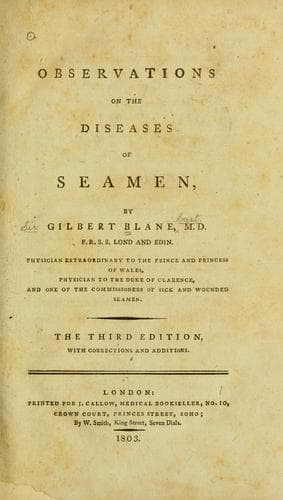
Observations on the Diseases of SeamenBlane, Gilbert, Sir
History
Observations on the Diseases of Seamen
Blane, Gilbert, Sir
Medicine, Naval -- Early Works To 1800; Sailors -- Diseases
There is no article of the _Materia Medica_ yet known that possesses
any considerable power over this disease without the assistance of
proper diet. With this assistance, however, it is found, that whatever
tends to increase the fluid secretions, hastens very much the recovery
of the scorbutic patient. I have observed a very striking instance of
this in the effects of a spontaneous diarrhoea; for I have seen those
hard livid swellings on the legs, that form one of the most constant
symptoms of this disease, almost disappear, and the hams, from being
contracted, become flexible in the course of twelve hours after the
purging came on. I have endeavoured to imitate this with purgatives,
but never with the same effects as the natural looseness. A free
flow of urine is also found to promote the recovery, and vinegar of
squills is one of the most effectual medicines in this intention. It
is likewise of singular service to excite sweat; for an obstruction
of perspiration seems to be one of the principal constituents of the
disease. The goose skin, which is an early and constant symptom of this
disease, seems to be owing to a constriction of the exhaling vessels.
Dover’s powder has been employed with advantage as a sudorific, with
decoction of the woods drank warm, and plentiful warm dilution.
Camphor, combined with nitre, has been found one of the best remedies,
and it acts both as a diaphoretic and diuretic.
Such external applications as relax the skin are found also to forward
the cure. The contraction of the hams and the livid hardness of the
calves of the legs are relieved by emollient cataplasms. Burying the
legs in the earth, which has a sensible good effect, seems to act on
the same principle, for it makes the parts sweat profusely.
There can be no doubt that in the scurvy there takes place in certain
parts of the body a stagnation of the humours in the small vessels,
particularly of the lower extremities, and that it is to this
circumstance that the livid hardness of the fleshy parts of the legs
is owing. The effect of medicine in removing this, must be to restore
the action of those torpid vessels, so as to bring the stagnated
fluids again into circulation[121] Purgatives seem to act upon it as
they do in the dropsy, by exciting absorption. The irritation of the
bowels and their increased secretion thus affecting the minute vessels
in all parts of the body, is the result of that sympathy or balance
established between every part of the system, in order to support the
harmony and effect the purposes of the animal œconomy.
Public-domain text, read in full here on John Shaqi.
Reviews
Reviews
No reviews yet
Be the first to share your thoughts on this work.
Elsewhere in the archive
Join the Discussion
Join the discussion
Sign in to leave a comment or review.
Sign InorCreate an account