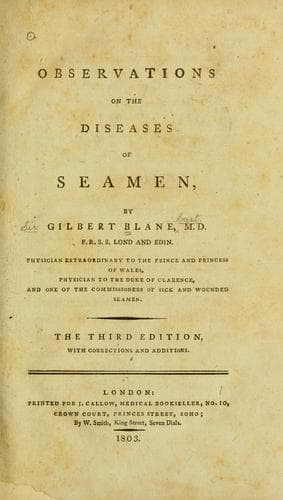
Observations on the Diseases of SeamenBlane, Gilbert, Sir
History
Observations on the Diseases of Seamen
Blane, Gilbert, Sir
Medicine, Naval -- Early Works To 1800; Sailors -- Diseases
It has long appeared to me, that the scurvy is owing rather to a defect
of nourishment than to a vitiated state of it. In fact, that sort of
food which is supposed most commonly to induce the scurvy, is, in most
cases, not putrid, but is in an unnatural and depraved state by being
drained of its juices, which run off in brine; and perhaps some of the
more subtile and nutritious parts are wasted by evaporation. It is not
found that salt of itself has any effect in inducing the scurvy, and
indeed it can be induced under a state of diet in which there is no
salt, as we know from some instances quoted by Dr. Lind; and some cases
are related by Dr. Monro and Dr. Milman, in the Medical Transactions,
which are in proof of the same opinion. But the case most in point to
prove that it depends on a defect of aliment, is that of Dr. Stark,
who, by way of experiment on himself, reduced his diet to the least
quantity he could subsist upon, and was thereupon affected with the
symptoms of the sea scurvy. I have also known some symptoms of it arise
in old people in consequence of long abstinence, owing to the want of
appetite.
It would appear that the aliment we take in acts in two ways in
increasing the vigour of the body. First, by assimilation, whereby it
affords the matter of which the solids of the body are made, in order
to carry on growth in youth; and to repair the waste of parts in adult
age. A very small quantity of matter is necessary for these purposes;
and as a proof of it, we see people supported equally well with very
different quantities and qualities of food. Secondly, Food is necessary
as a stimulus, either by a power it has of soothing the nerves of the
stomach, and the other surfaces to which it is applied, or by its
volume in distending the intestines and blood vessels. It is upon this
principle that luxury renders the great quantities of food we take
in necessary; and those species of food which satisfy most by their
stimulus are by no means such as are the most nutritious. It is also
upon this principle, that in cases of accidental hardship from want
of food, or in barren and inclement countries where food is scarce,
the body is supported, in some measure, by what contains little or no
nutritious matter, such as pure water, or the bark of trees powdered
and kneaded into a sort of bread, as we are told of the inhabitants of
Lapland.
Public-domain text, read in full here on John Shaqi.
Reviews
Reviews
No reviews yet
Be the first to share your thoughts on this work.
Elsewhere in the archive
Join the Discussion
Join the discussion
Sign in to leave a comment or review.
Sign InorCreate an account