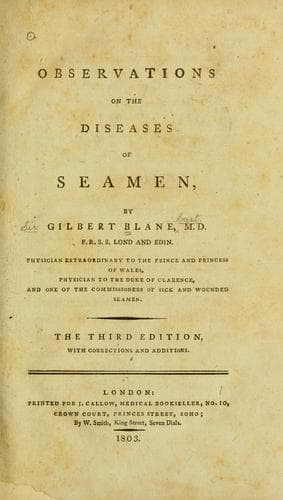
Observations on the Diseases of SeamenBlane, Gilbert, Sir
History
Observations on the Diseases of Seamen
Blane, Gilbert, Sir
Medicine, Naval -- Early Works To 1800; Sailors -- Diseases
There is a singular species of accident to which engagements at sea
are liable, the WIND OF A BALL, as it is called. If a cannon ball in
its flight passes close to any part of the body, it renders it livid
and numb for some time[132]. It is most dangerous when it approaches
the stomach; and there was an instance of a man in the last battle,
who, upon a ball passing close to his stomach, dropped down dead
instantaneously, without the least visible marks of injury. Another,
in consequence of a ball passing close to his belly, remained without
sense or motion for some time, and a large livid tumor arose on the
part, but he recovered. I attended a man at the hospital at Barbadoes,
who had the buttons of his trowsers carried off by a cannon ball,
without its having touched the body. The _pubis_ was livid and swelled
for some time after: he suffered exquisite pain from strangury, which
seemed to proceed from a _paralysis_ of the bladder, for he voided no
water without a catheter for near three months, after which time he
recovered. I know a brave young officer[133] in the army, who had his
epaulette carried off by a cannon ball at Charlestown, in consequence
of which the shoulder and adjacent parts of the neck were affected
for some time. A like accident happened to a marine officer in one of
the late engagements; but in neither of these was the head materially
affected, nor is it so apt to be affected in this way as the stomach.
I never knew death the consequence of the wind of a ball on the head;
though an officer[134] in the Sultan, at the battle of Grenada, was so
stunned by a shot passing near his temple, as to be insensible for some
time, but he recovered entirely in a few hours[135].
Public-domain text, read in full here on John Shaqi.
Reviews
Reviews
No reviews yet
Be the first to share your thoughts on this work.
Elsewhere in the archive
Join the Discussion
Join the discussion
Sign in to leave a comment or review.
Sign InorCreate an account