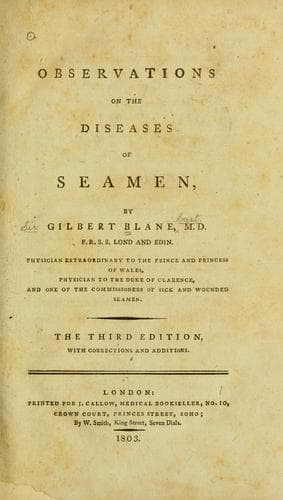
Observations on the Diseases of SeamenBlane, Gilbert, Sir
History
Observations on the Diseases of Seamen
Blane, Gilbert, Sir
Medicine, Naval -- Early Works To 1800; Sailors -- Diseases
But there is no infection of any kind, however virulent, that affects
indiscriminately all persons exposed to it. If a number of persons,
who never have had the small pox, are equally exposed to it, some will
be seized, while others will escape, who will be affected at another
time, when they happen to be more susceptible. It is doubtful how far
the habit of being exposed to such specific infections renders the
body insensible to them, as was said with regard to fevers; but there
is another principle of the animal œconomy laid down and illustrated
by Mr. Hunter, which goes at least a certain length in explaining
this variable state of the body with respect to its susceptibility
of infectious diseases. This principle is, that the body cannot be
affected by more than one morbid action at the same time. If a person
is exposed to the small pox, for instance, while he labours under a
fever, or while he is under the influence of the measles, he will not
catch the first till the other has run its course. It may happen,
therefore, that people escape the effect of contagion in consequence
of being at the time under the influence of some other indisposition,
either evident or latent: and supposing the body to be exposed to a
number of noxious powers at the same time, one only could take effect.
But it seems difficult to explain why some of those who are actually
seized, and who have previously been to all appearance in equally good
health, shall have it in a very mild degree, while in others it will
be malignant and fatal. This is very remarkable with regard to the
small pox, which are in some cases so slight, that they can hardly be
called a disease, while in others they are so malignant, as hardly to
admit of any alleviation from art. May not this, in some measure, be
explained from some of the principles above mentioned, in the following
manner:--The small pox, in their mildest form, are attended with little
or no fever, which, therefore, is not essential to them; and when we
see them attended with various forms of fever, and thereby prove fatal
even in the most hale constitutions, we ought not to attribute this to
any thing in the nature of the small pox, but rather to say, that they
have served as an agent in exciting a fever, for which there happened
to be some previous latent disposition, that would not otherwise have
exerted itself, and that this disposition, or contamination, as it
may be called, may have been induced by some past exposure to morbid
effluvia, which either from habit, or some other circumstance, may not
have been sufficiently powerful to excite the constitution to fever
without some such stimulus. Any other occasional circumstance producing
disturbance or irregularity in the functions of the body, may, in like
manner, excite any particular kind of fever to which the body may at
that time be disposed. Thus the amputation of a limb will have this
effect; also exposure to cold or fatigue, and intemperance in eating or
drinking.
Public-domain text, read in full here on John Shaqi.
Reviews
Reviews
No reviews yet
Be the first to share your thoughts on this work.
Elsewhere in the archive
Join the Discussion
Join the discussion
Sign in to leave a comment or review.
Sign InorCreate an account