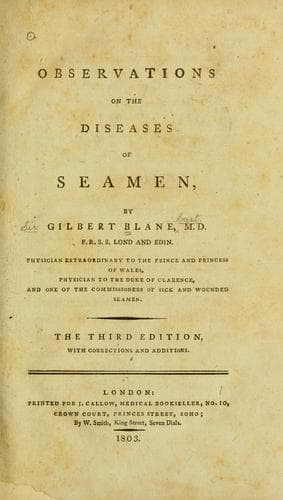
Observations on the Diseases of SeamenBlane, Gilbert, Sir
History
Observations on the Diseases of Seamen
Blane, Gilbert, Sir
Medicine, Naval -- Early Works To 1800; Sailors -- Diseases
It would appear from these considerations, that there are certain
circumstances, or temporary situations of constitution, which invite
infection, and render its effect more certain and violent in one case
than another. There are artificial methods, however, of obtruding it,
as it were, upon the constitution, though not particularly disposed, or
even though averse to receive it; and may not this, in some measure,
account for the greater safety of some diseases when communicated by
inoculation, than when caught in the natural way?
But these, as well as many other facts in animal nature, do not admit
of a satisfactory explanation upon any principle as yet known. Even the
most common operations of the body, such as digestion and generation,
when considered in their causes and modes of action, are so obscure and
mysterious, as to be almost beyond the reach of rational conjecture. A
little reflection will teach us the utmost modesty with regard to our
knowledge of such things; for nature seems to have innumerable ways
of working, particularly in the animal functions, to which neither
our senses can extend, nor perhaps could our intellects comprehend
them. Had we not, for instance, been endowed with the sense of sight,
nothing could have led us even to suspect the existence of such a
body as light; and there may be numberless other subtile and active
principles pervading the universe, relative to which we have no senses,
and from the knowledge of whose nature and exigence we must for ever
be debarred. We have, indeed, become acquainted with electricity by
an operation of reason; and animals have lately been discovered to
which the electric fluid serves as a medium of sense through organs
calculated to excite it, and to receive and convey its impressions.
But there are few subjects we can study that are more subtle and
obscure than the influence of one living body on another. There is a
familiar instance of the great subtilety of animal effluvia, and also
of the fineness of sense in a dog’s being able to trace his master
through crowds, and at a great distance; and we can conceive that
infectious matter may adhere, and be communicated in a similar manner.
We have endeavoured to illustrate the great obscurity of its operation
by an allusion to generation, digestion, and other animal functions,
with which it is equally obscure and inexplicable. It is similar to
generation in this, that its influence does not pass from one species
of animal to another; for the poison of the plague, that of the small
pox, that of fever, and the venereal disease, do not affect brutes[47],
nor do the infectious diseases of brutes affect different species of
them, nor the human species. The only exception to this, that we know
of, is the bite of a mad dog.
Public-domain text, read in full here on John Shaqi.
Reviews
Reviews
No reviews yet
Be the first to share your thoughts on this work.
Elsewhere in the archive
Join the Discussion
Join the discussion
Sign in to leave a comment or review.
Sign InorCreate an account