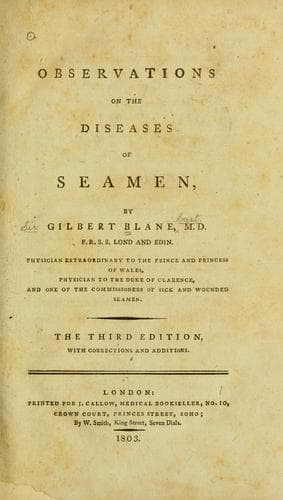
Observations on the Diseases of SeamenBlane, Gilbert, Sir
History
Observations on the Diseases of Seamen
Blane, Gilbert, Sir
Medicine, Naval -- Early Works To 1800; Sailors -- Diseases
[50] At the time I am writing this, (March 8th, 1785) there has
occurred a fact which proves the effect of time in generating
infection. There now prevails a contagious fever in several of
the hospitals in London, and, among others, in that to which I am
physician. In another hospital it has been so violent, that there has
been a vulgar report that the plague had broke out in it. The same
fever also prevails among the poor at their own houses. The cause
of it seems to be, that the cold weather has been uncommonly long
and severe; for the frost began early in December, and the cold has
hitherto been more like that of winter than spring. The thermometer
all this month has varied from 30° to 35°. Cold is favourable to
infection, by preventing ventilation; for people exclude the air in
order to keep themselves warm, and the poor in particular do so on
account of their bad clothing, and their not being able to afford fuel
to make good fires. Heat is the great destroyer of infection, and seems
to act by evaporating, and thereby dissipating it; and the effect of
fires in apartments is to produce a constant change of air, thereby
preventing its stagnation and corruption, and the accumulation of
unwholesome effluvia. With this view, a chimney is of great use, even
though no fire should be kept in it, as it serves for a ventilator.
But if an aperture were to be made in an apartment merely with a view
to ventilation, it should be placed in that part of the wall next the
ceiling; for foul air naturally tends upwards, and the external air
entering at the top of a room, would not be so apt to subject those
within to the effect of cold, as it would not blow directly upon them.
There would also be this advantage in jails, that apertures in this
situation would not be so liable to be forced for the purpose of escape
as if they were nearer the floor; and in hospitals they would be out
of reach of those who, wishing to indulge in warmth, at the expence
of pure air, might be induced to shut the windows. But an external
communication with the air any where is of the utmost importance; and
it is observable in Mr. Howard’s account of prisons, that the jail
distemper was most frequently to be met with where there was no chimney.
[51] It is of some consequence to attend to the materials of the
seamen’s beds; for, instead of flock, they are frequently fluffed with
chopped rags, which, consisting of old clothes, emit a disagreeable
smell, and may even contain infection.
[52] By a _berth_ is understood the interval between two guns, or any
space between decks, which is sometimes formed into a sort of apartment
by means of a partition made of canvass.
[53] It is remarkable that this method of purifying was practised in
the most ancient times, as we learn from the following passage in
Homer, where Ulysses is represented fumigating the apartments of his
palace in which the suitors had been slain:
Public-domain text, read in full here on John Shaqi.
Reviews
Reviews
No reviews yet
Be the first to share your thoughts on this work.
Elsewhere in the archive
Join the Discussion
Join the discussion
Sign in to leave a comment or review.
Sign InorCreate an account