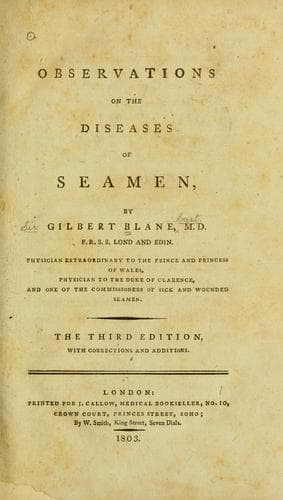
Observations on the Diseases of SeamenBlane, Gilbert, Sir
History
Observations on the Diseases of Seamen
Blane, Gilbert, Sir
Medicine, Naval -- Early Works To 1800; Sailors -- Diseases
[109] The state of the stomach is very much affected by that of the
external surface of the body; and it is sagaciously observed by
Sydenham, that the stomach being commonly very irritable in the plague,
the most effectual means of making it retain what was administered
internally was to excite a sweat.
[110] The red bark was brought to England in a Spanish prize in the
year 1781, and a very accurate account of its medical and chemical
properties was published the year after by Dr. William Saunders, of
Guy’s hospital. None of it had been brought to the West Indies before
the peace, so that I had no opportunity of trying it in that climate.
[111] Mr. Telford related to me, that he had cured several
intermittents that had baffled the bark, by means of white vitriol,
whilst he was surgeon of the Yarmouth in 1779. He gave it in doses of
five grains every four hours in the intermission, and was successful in
every case except two, in which the patients were far advanced in the
dropsy.
He met with several cases of the same kind in the Alcide, in 1782,
in which he was successful with the flowers of zinc, after having
given large quantities of bark to no purpose. He preferred, however,
the white vitriol, as being milder in its operation, and less apt to
disagree with the patient’s stomach.
He did not employ either of them in the recent state of the disease,
nor does he assert that they are universal or infallible remedies; but
only alledges, that he has experienced the most evident good effects
from them in an advanced stage of the disease, and a reduced state of
the patient, where the common remedy had failed.
[112] Dr. Huck Saunders, whose recent loss the world has reason to
regret on account of his experience and sagacity as a physician, as
well as his virtues as a man, communicated to me, in conversation, some
observations on the cure of obstinate intermittents, which deserve to
be mentioned here. When he was physician to the army at the Havannah
he cured a number of agues which had resisted the bark, by giving two
ounces of the vinous tincture of rhubarb and six drams of the tincture
of sena seven or eight hours before the fit. This being repeated two or
three times, carried off the disease. He also informed me, that he had
met with agues in England which did not yield to the bark; but, upon
leaving it off, and putting the patients on a course of mercury, they
were cured upon returning to the use of the bark.
Public-domain text, read in full here on John Shaqi.
Reviews
Reviews
No reviews yet
Be the first to share your thoughts on this work.
Elsewhere in the archive
Join the Discussion
Join the discussion
Sign in to leave a comment or review.
Sign InorCreate an account