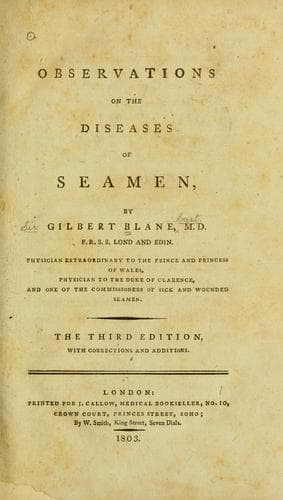
Observations on the Diseases of SeamenBlane, Gilbert, Sir
History
Observations on the Diseases of Seamen
Blane, Gilbert, Sir
Medicine, Naval -- Early Works To 1800; Sailors -- Diseases
Arsenic has also been found to be an effectual remedy in intermittent
fevers. I was informed by Dr. Huck Saunders, that when he was in North
America, in the war before the last, there was an expedition undertaken
against the Cherokee Indians, whose country is extremely subject
to agues; and as an adequate quantity of bark would have been very
cumbersome where light service was necessary, Mr. Russel, who had the
medical management of the expedition, provided a great number of pills,
containing each one eighth part of a grain of arsenic, by the proper
use of which he was enabled to cure the intermittent fevers with which
the troops were seized.
I shall here mention another unusual remedy in intermitting fevers;
and though I can bring only one instance in proof of its efficacy, yet
this is so strong as to make it deserve farther trial. A man, on board
of the Sandwich, had an obstinate intermittent which had resisted the
bark, and was stopped by applying to the stomach a plaster, composed of
gum plaster, epispastic plaster, and opium, in proportions which I do
not now recollect.
[113] Sir John Pringle on the Diseases of the Army.
[114] This is elegantly expressed as follows, in Sir George Baker’s
learned Dissertation on this disease:--“Primo neglectus tractatu
asperior occurrebat: etenim corpus extenuatum atque confectum ut morbo
fervido impar erat, ita ipsi impar curationi. Itaque optimum erat
occurrere ipsis principiis atque auxilia mature præripere. In hoc enim
corporis affectu aliquod certe in medicina opus est, haud multum in
naturæ beneficio.”
[115] In Dr. Griffith’s form of his medicine for the piles, six drachms
of fresh-drawn linseed oil are joined with two drachms and a half of
the vinous tincture of rhubarb, and given twice a day in a draught. I
commonly used oil of almonds at the hospital. This may be considered
as another instance of those useful combinations of medicines, which
experience alone sometimes discovers. I have found it of use also in
other internal hæmorrahages.
[116] See Diseases of the Army, p. 273. 6th Edit.
[117] Since coming to England, I have been informed by Dr. Garden,
a learned and ingenious practitioner from South Carolina, that this
medicine, in order to produce its proper effect, should be given in
a very weak decoction; for that after having almost abandoned it in
consequence of its failure when he gave it in strong decoctions, and
in substance, he was again convinced of its efficacy by using it in a
very weak decoction, a scruple being boiled in a pint of water to half
a pint.
[118] See page 345. A fact mentioned in Capt. Cooke’s Voyage to the
North Pacific Ocean, may be also alledged in favour of this opinion.
He remarks, that the Kamschadales, who were habituated to hard labour,
were free from scurvy, while the Russians and Cossacks, who were in
garrison in their country, and led indolent lives, were subject to it.
Public-domain text, read in full here on John Shaqi.
Reviews
Reviews
No reviews yet
Be the first to share your thoughts on this work.
Elsewhere in the archive
Join the Discussion
Join the discussion
Sign in to leave a comment or review.
Sign InorCreate an account