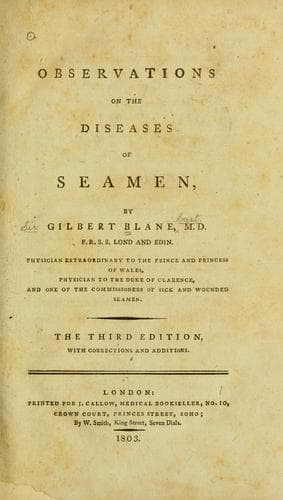
Observations on the Diseases of SeamenBlane, Gilbert, Sir
History
Observations on the Diseases of Seamen
Blane, Gilbert, Sir
Medicine, Naval -- Early Works To 1800; Sailors -- Diseases
[119] I was informed of this fact by Mr. Cairncross, an ingenious
surgeon belonging to one of the battalions that served there during the
siege.
[120] I imagined that this was a new practice; but I find, since the
first edition of this work was printed, that it has been recommended by
Pere Labat in his voyage to the Antilles.
[121] There is a symptom which takes place when men are beginning to
recover from scurvy, (particularly when the cure is rapidly effected
by the use of lemon and orange juice) upon which I have frequently
reflected, but for which I have never been able to account. This
consists in acute pains, which are felt in the breast and limbs,
resembling rheumatic pains. I once knew the crew of a ship which was
much affected with scurvy, and had about ninety men under cure by
lemons and oranges, who were most of them affected with this symptom in
one night, and made such a noise by crying out as to alarm the officers
who were upon duty.
[122] See the Medical Essays of Edinburgh. Sennertus, lib. iii. part i.
sect. ii.--Haller Elem. Physiolog. lib. xix. sect. ii.
[123] In the Princessa, 1781, and the Nonsuch, Prince George, and Royal
Oak, in 1782.
[124] Since this was first written, the melancholy tidings have
arrived of another case to be added to this fatal list. It is that
of the amiable and gallant Lord Robert Manners, who commanded the
Resolution on the 12th of April, and having lost his leg, besides
receiving a wound in his arm and breast, died of this untractable
symptom on his passage to England; and though he shared a fate to be
envied by every lover of true glory, his loss can never be enough
deplored by his country and friends, being formed by his great virtues
and accomplishments, joined to the lustre of his rank, to hold out an
example of all that was good and great as a man and an officer.
[125] See Kaau Boerhaave’s account of this epilepsy in a school at
Harlaem, in a book, entitled Impetum faciens dictum Hippocrate per
corpus consentiens (page 355.) A fact of the same kind is also related
in a pamphlet, entitled Rapport des Commissaires chargés par le Roi de
l’examen du Magnetisme Animal.
[126] London Medical Observations and Inquiries, Vol. VI.
[127] Medical Commentaries, Vol. III., and a Thesis printed at
Edinburgh, 1784.
[128] See experiments on a heated room. Philosophical Transactions,
1775, Vol. LXV.
[129] That species of locked jaw, called by authors the _Trismus
Infantium_, to which children are liable the first week after birth, is
probably owing to the contact of the external air upon the skin, which
is accustomed in the womb to a moist and warm medium.
[130] Aretæus Cappadox says, that tetanus in general is even more apt
to occur in winter than in summer. De Cauf. & Sign. Morb. Acut. lib. i.
cap. vi.
Public-domain text, read in full here on John Shaqi.
Reviews
Reviews
No reviews yet
Be the first to share your thoughts on this work.
Elsewhere in the archive
Join the Discussion
Join the discussion
Sign in to leave a comment or review.
Sign InorCreate an account