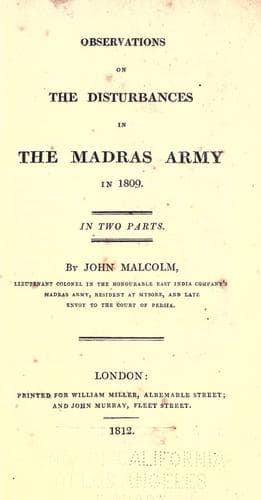
Observations on the Disturbances in the Madras Army in 1809Malcolm, John
History
Observations on the Disturbances in the Madras Army in 1809
Malcolm, John
India. Army -- History; Malcolm, John, 1769-1833
There were many circumstances connected with these addresses, which
confirm the truth of those sentiments I before expressed regarding
the feelings by which General McDowall allowed himself to be governed
at this moment: but the state of his mind, and the operation that
was likely to have upon the officers of the army, was a subject
that merited the serious consideration of Government; which, unless
satisfied that there was no danger from the progress of such a spirit
of discontent as then existed, should either have adopted _at that
moment_ some decided measures to repress that evil, or have carefully
avoided every act of aggravation. If both of these Memorials had been
merely permitted to go as numbers of the dispatch to England, those
by whom they were signed would have thought nothing more of their
grievances till an answer was received from the Directors: and that,
if contrary to their wishes, would have been deemed final, and the
Directors would assuredly not have censured Government for a slight
departure from established rules at a period when, from extraordinary
events, of a nature never likely to happen again, the army was not
only in a state of great agitation, but the civil power had lost the
aid of that high military authority on which it would in common times
have relied to subdue so dangerous a spirit. Few will contend that
there would have been any loss of either dignity or of strength in
such a proceeding: and how completely, had it been adopted, would
the turbulent and seditious be deprived of one of their chief means
of increasing irritation[3]. But this question appears to have been
decided, like every other, upon an abstract consideration of its own
merits as a single and insulated question; and in that light the
decision was _undoubtedly right_: but if it had been viewed, as it
certainly should, in its relation to the actual state of the army,
_it was as certainly wrong_. It had an evident and malignant action
throughout all the troubles that ensued. And this absolute, and, as
they deemed it, unnecessary and ungracious refusal to allow their
grievances to be even heard by the Court of Directors, combined with
the punishment[4] with which it was accompanied, rankled to the last in
the minds of the discontented, and indeed appeared to be one of the few
subjects, on the hardship and injustice of which the most moderate of
those concerned agreed with the most violent.
Public-domain text, read in full here on John Shaqi.
Reviews
Reviews
No reviews yet
Be the first to share your thoughts on this work.
Join the Discussion
Join the discussion
Sign in to leave a comment or review.
Sign InorCreate an account