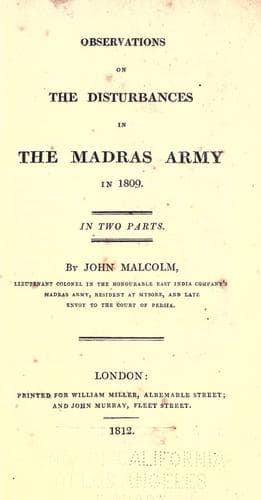
Observations on the Disturbances in the Madras Army in 1809Malcolm, John
History
Observations on the Disturbances in the Madras Army in 1809
Malcolm, John
India. Army -- History; Malcolm, John, 1769-1833
_8th July._ Nothing particular occurred this day. Some further
communications from the westward were shown to me; one of which
strongly recommended Masulipatam being kept, and not abandoned; and
a force of two battalions of sepoys and one regiment of cavalry were
promised to support the garrison, and the corps of the district, all of
whom they appeared to think would join. I entered at great length this
day into the whole subject with M. H., who, I knew, was in intimate
communication with all the senior officers, and had some influence
even with the junior. I pointed out to this officer what must be the
consequence of the whole or any part of the Company's army plunging
down that precipice, on the brink of which they were now standing.
I exposed the falseness of that confidence on which numbers were
proceeding; how they would be deserted by their brethren and their
men, when Government was compelled to declare them in rebellion. I
pointed out how wretched their means, how unconnected their plans; and
demanded, if even they had double the numbers, if he thought, after the
chain of discipline was once broken, and when they were commanded by
committees, and every boy thought he possessed the right to question
the authority of his superior, whether it was possible to oppose
the organized army that must, under all circumstances, remain with
Government, and which must every day gain strength from their ranks?
The whole of the king's army was, I said, decidedly with Government:
and if the last step was taken, many of the Company's officers, and
those probably who had the most influence with the native troops, would
range on the side of authority. I knew this, I said, to be fact,
because I had letters, fully expressive of their sentiments, from some
of the best and most popular officers in the army. I was myself, I
said, of that opinion, and proud to state it. I had been in this army
since I was twelve years of age; and such was my regard for my brother
officers, that I would give my life to see the present unfortunate
disputes happily adjusted: but if any circumstances whatever led these
officers to rise in rebellion against their King and Country, and such
they would do the moment they threw off their allegiance to the legal
constituted authority in India, I must stand in the opposite rank:
and I was convinced so many would be found of the same sentiments,
that Government must triumph, though I allowed such a triumph would
be one over its own strength, and consequently more mournful than
the most signal defeat from a foreign enemy. I added, that I would,
for the sake of argument, suppose, what I conceived impossible, that
Government was destroyed in the conflict, what would be the consequence
of this victory to a few officers who had led the natives of India to
the murder of their countrymen and to the destruction of the British
Government? Would these natives allow them to live and rule over them?
Public-domain text, read in full here on John Shaqi.
Reviews
Reviews
No reviews yet
Be the first to share your thoughts on this work.
Elsewhere in the archive
Join the Discussion
Join the discussion
Sign in to leave a comment or review.
Sign InorCreate an account