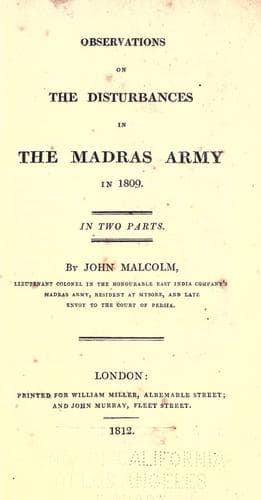
Observations on the Disturbances in the Madras Army in 1809Malcolm, John
History
Observations on the Disturbances in the Madras Army in 1809
Malcolm, John
India. Army -- History; Malcolm, John, 1769-1833
Or would they not be tempted to practise, for the last time, the lesson
they had been taught, and get rid at once of a race whose rule they
had been taught to consider as oppressive and tyrannical? Supposing
they did not, would the King and people of England be ready to make
peace with men whose hands were red with the blood of their countrymen?
Would they not rather, if they did not abandon this quarter of India
altogether, attempt its reconquest? And to what consequence would that
lead? You say, I added, that your grievances are intolerable, and that
if you abandon your attempts to obtain redress the coast army will be
disgraced, while, if you persist with firmness and spirit, Government
(which must be aware of all the consequences I have stated) must give
way. To this I answer: No grievances of the description this army now
has, can warrant its having recourse to arms, because they are such
as must come under the cognizance of the controlling and legislative
authorities in England, who are alone competent to notice and redress
them: and this army, so far from being degraded by a moderate
proceeding at a moment like the present, would raise its reputation
higher than ever; because it would prove to all the world that it
possessed a spirit of the highest loyalty and patriotism; and that when
a variety of circumstances had combined to throw it into a flame, the
action of these feelings had subdued every other, and it was contented
rather to suffer, till the superior authorities in England could judge
all those questions on which it thought itself aggrieved, than endanger
the general interest of the country. Would such sentiments, I asked,
redound to the disgrace or to the honour of this army? With respect,
I observed, to the probability of Government giving way, if assailed
with unanimity, firmness, and spirit, there was, I feared, a great
and dangerous error. Government could not give way, as it was termed,
beyond a certain point, without destroying itself; and it had better
fall by any hands than its own. It was the very pressure, I added, that
was brought against it, that forced it to resistance: and, besides,
what were the points which it was required to yield? In the present
agitated period of the army, every committee, every individual, had a
different opinion; and if it were possible to collect the general sense
of the army, I believe, in their present irritated state, concessions
would be required that would amount to the virtual abolition of the
existing local Government of this Presidency. It was no doubt, I
observed, the duty of Government to take every step that it could take
with dignity to restore temper, and to compose men's minds; but I, for
one, would never blame it for refusing its consent to its own death;
and such I should consider any act that made a substantial sacrifice
of its strength or authority. From the answer of the gentleman to whom
these observations were made, I could perceive that he and many others
Public-domain text, read in full here on John Shaqi.
Reviews
Reviews
No reviews yet
Be the first to share your thoughts on this work.
Elsewhere in the archive
Join the Discussion
Join the discussion
Sign in to leave a comment or review.
Sign InorCreate an account