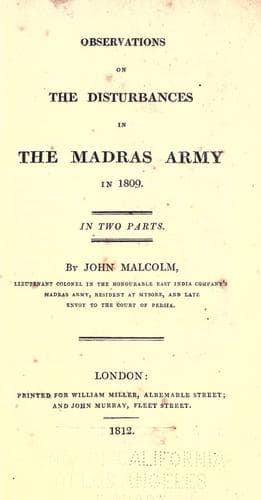
Observations on the Disturbances in the Madras Army in 1809Malcolm, John
History
Observations on the Disturbances in the Madras Army in 1809
Malcolm, John
India. Army -- History; Malcolm, John, 1769-1833
It was a remarkable fact, relative to the orders issued on that date,
that (unless in the case of Captain Grant, who had come forward to
accuse himself[8] of the act for which he was punished) no proof
of the guilt of any of the others was brought forward. They were,
indeed, almost all suspended, removed, and disgraced, on the grounds
of private information; which, supposing it true, could not, from its
nature, and the resentment to which it would expose individuals, be
publicly stated. The consequence was, that many of the individuals
who had been thus condemned and punished without a hearing, loudly
declared their innocence, and brought strong presumptive evidence to
support their assertion. They were generally believed; and a sense of
their particular wrongs, added to the alarm caused by the sweeping use
which Government had on this occasion made of its right of suspending
officers without trial, greatly aggravated the discontented, who felt
an almost maddening motive to action in the immediate contemplation of
the ruin and disgrace which threatened some of the most honourable and
distinguished of those that had taken any share in their proceedings.
The obvious and acknowledged source of the crimes which Government had
at this moment to punish, was its own act--the recent suspension of
Lieutenant-Colonel Capper and Major Boles; and it ought to have been
evident, that the orders of the 1st of May would aggravate, in the
highest degree, the general agitation which that measure had produced;
and almost every paragraph of this order would appear as if intended
for that object. The thanks given in it to his Majesty's troops were
no doubt merited, but invidious; and, being so, could never have been
desired by that body; many of whom, though they had been led (by the
operation of the principles of the distinct constitution of the army
to which they belonged,) to renounce every share in the proceedings of
the discontented officers in the Company's service, still participated
in their feelings: but the useless irritation of this part of the
order appears a trifling error when compared to that eulogium which
it so unfortunately bestowed on the Hyderabad force, whose officers,
however much circumstances might have prevented their coming forward,
could not possibly, as a body, have a separate interest from the rest
of that army to whom they were on this occasion held forth as a corps
on whose fidelity Government had peculiar confidence. The operation
of such praise was inevitable: the Company's officers at Hyderabad
were not only exposed to the reproach of inaction in what were deemed
objects of common interest, but to the accusation of being in part the
cause of the ruin of some of the most popular officers of the army: for
the discontented argued, that if Government had not thought it could
rely on their support, it never would have had recourse to so bold
and arbitrary a course of measures. Correct information regarding the
Public-domain text, read in full here on John Shaqi.
Reviews
Reviews
No reviews yet
Be the first to share your thoughts on this work.
Join the Discussion
Join the discussion
Sign in to leave a comment or review.
Sign InorCreate an account