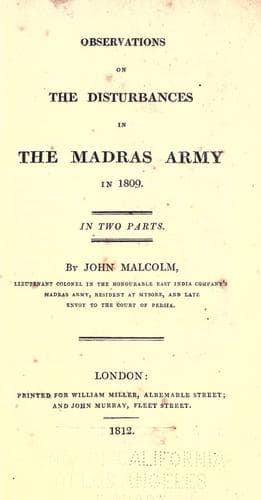
Observations on the Disturbances in the Madras Army in 1809Malcolm, John
History
Observations on the Disturbances in the Madras Army in 1809
Malcolm, John
India. Army -- History; Malcolm, John, 1769-1833
reputation, had the chief management of all the criminal proceedings.
This party, which consisted of a few wrong-headed and violent old
officers, and almost all the junior part of the service, completely
took the lead in their correspondence and deliberative committees;
in both of which a very violent and indecent tone of proceeding
was adopted; and the authority of commanding officers of corps was
apparently suspended by the principle of equality introduced in their
proceedings. But this loss of power was more apparent than real; for,
though the commanding officers may have had little more influence in
the committee than the youngest officers, their military authority
(generally speaking) remained, and that must have given them, whenever
they had the courage to exert it, a very commanding influence over the
whole: and this circumstance establishes what has been before stated,
that the most numerous, clamorous, and violent, were in fact the least
powerful party in the army, though they have assumed a style in the
written documents, as if they were the undisputed and uncontrolled
leaders of the whole of the Company's army.
The objects of the different classes of officers were, of course, as
various as their feelings. The first could have no wish, but such a
settlement as should vindicate the dignity of Government, and, as far
as possible, spare the character and reputation of the service. They
were too well aware of the nature of those causes that had led the
discontented astray, not to hope that every effort might be made to
reclaim the misguided; but they were prepared, if such efforts failed,
to have acted with a forward and animated zeal in support of lawful
authority, and to have contributed their efforts to reduce men who
had shown themselves unworthy of kindness and indulgence. The next
class that has been described required more aid from the consideration
of Government, before they could disentangle themselves from those
unfortunate pledges into which they had entered. They felt that, after
having proceeded so far, they would have been disgraced if they had,
by their retreat, left their associates to be punished. These officers
thought they could not abandon the cause before it was at least
ascertained none should suffer for what had passed; but they had become
fully sensible of the deep guilt in which they were involved: and
though many of this class had entered into a pledge to have obtained
what was termed a redress of grievances (inclusive of a complete
repeal of the orders of the 1st of May), they were not disposed to
persevere to the extent of disobedience in the pursuit of this object:
and had Government, in addition to an act of amnesty, held out the
slightest prospect that the officers of the army would, by an immediate
return to good order and duty, acquire a claim upon the clemency and
consideration of the Court of Directors, which might operate favourably
to those officers who were suspended, and who were the object of their
Public-domain text, read in full here on John Shaqi.
Reviews
Reviews
No reviews yet
Be the first to share your thoughts on this work.
Join the Discussion
Join the discussion
Sign in to leave a comment or review.
Sign InorCreate an account