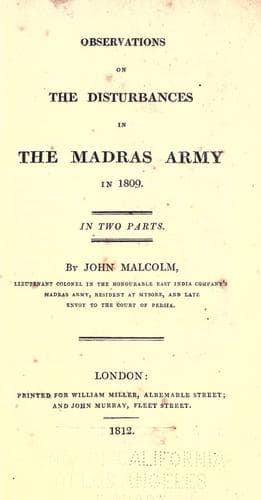
Observations on the Disturbances in the Madras Army in 1809Malcolm, John
History
Observations on the Disturbances in the Madras Army in 1809
Malcolm, John
India. Army -- History; Malcolm, John, 1769-1833
"On the afternoon of the 23d ultimo[16], Secunder Khan Subahdar
came to me, on my return from Madras to camp, and said he had been
very anxious to see me for several hours, as something of a very
extraordinary nature had occurred. That walking in the vicinity of the
lines he had been accosted by a brahmin, who asked him if he was not
the senior officer of cavalry, and said he had business of the greatest
importance to communicate to him. He then proceeded to disclose to him,
that he had been sent by Colonel Munro to inform the native troops that
their officers had sent in a petition to Sir George Barlow to be put on
Bengal allowances, which Sir George had informed them the resources of
this country would not admit; and, in consequence of this refusal, they
had resolved to mutiny: that in case the officers should propose to
engage them in seizing the person of Sir George, it was their duty to
say he was their Governor, and that they would not act in such a cause.
The only way, _he further said, in which the demand of the officers
could be complied with, was by taking away a proportion of the pay of
the native officers and men_. That if Secunder Khan would undertake
to persuade all the men and officers to act in this manner, he should
receive a handsome jagheer: and he was further informed, that Colonel
Munro had dispatched emissaries or letters to communicate the same to
all the native corps in the army. That he had no occasion to apprehend
injury from any one, as he might observe Sir George had suspended every
person who acted in opposition to his wishes[17]."
Colonel Rumley was naturally indignant at a proceeding which he
was convinced (from the whole behaviour of Sir George Barlow) could
not have his sanction, and which he deemed, at the moment, to be an
impolitic and dangerous expedient of a person who, enjoying a large
share of his confidence, might have acted on this occasion without his
knowledge. With these impressions, he hastened to give full information
of the circumstance to Sir George Barlow; but his report was received
without either emotion or surprise; and he was forced to conclude, from
no notice being taken of it, that the measure of which he complained
had been adopted by authority. The circumstance became public after
Colonel Rumley returned to camp, and the minds of most of the officers
were greatly inflamed at this glaring instance of what they deemed
unmanly duplicity.
A short account of the mode in which the test was proposed to the
officers at Fort St. George and the camp near the Mount, will convey,
better than any general detail, the character of the measure. The
following is a copy of that remarkable document:--
Public-domain text, read in full here on John Shaqi.
Reviews
Reviews
No reviews yet
Be the first to share your thoughts on this work.
Join the Discussion
Join the discussion
Sign in to leave a comment or review.
Sign InorCreate an account