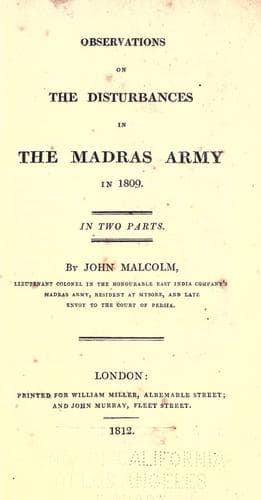
Observations on the Disturbances in the Madras Army in 1809Malcolm, John
History
Observations on the Disturbances in the Madras Army in 1809
Malcolm, John
India. Army -- History; Malcolm, John, 1769-1833
No previous effort whatever was made to dispose the minds of the
senior and more reflecting part of the Company's officers in favour
of this measure, though such a step (which could have been adopted
in many ways without the slightest hazard) seemed essential to its
success. A short and peremptory summons was sent to every Company's
officer of the garrison of Fort St. George, to attend at the quarters
of Colonel Conran, the commanding officer. That officer read the
circular letter to which I have alluded to the astonished officers
whom he had assembled; and then, presenting the test, informed them
they must either sign immediately, or go to Pulicat, the place fixed
for their banishment. Can any man the least acquainted with the human
mind be surprised, that an almost general and indignant rejection was
the result of such a proceeding? Five regimental officers only could
be prevailed upon to sign it at this meeting; and the remainder were
immediately sent to Pulicat[19]. At the Mount the rejection was still
more general. Colonel Hare had the day before removed his tents across
the bridge of Marmalon, where all the officers were summoned at an
equally short notice. When Colonel Hare read the circular letter,
presented the test for signature, and told them that those who refused
their signature would not be allowed to return to camp, they refused
with one general sentiment of indignation at the manner in which they
had been treated, and were immediately separated from their corps[20].
The test was signed by all the staff-officers at the Presidency, and
by some officers who were there on leave: at Trichinopoly twenty-two
signed it, but few others at any other station of the army. In short,
the whole number of signatures did not amount to one hundred out of
about one thousand two hundred, which is near the number of officers on
the coast establishment in India.
The almost total failure of this expedient (if it ever was intended to
reclaim or fix any officers in the Company's service to their duty,)
will not surprise any man the least acquainted with human nature,
and with the temper of those to whom the measure was proposed. Those
officers, who had never departed from their duty in thought, word, or
deed, felt this test, which was a mere repetition of the obligation
of their commission, as at least an act of supererogation; and it was
painful, as it had a taint of suspicion in it. Others, who were in
some degree pledged to support their brother officers, conceived that
this was an indirect mode of obtaining their individual pledges to act
against them; and concluded, from its being proposed, that every hope
of an amnesty was at an end[21]; whilst the more violent only saw in it
the pursuit of plans which banished every expectation from their minds
of obtaining personal security, much less the object they had in view,
through any means but successful resistance.
Public-domain text, read in full here on John Shaqi.
Reviews
Reviews
No reviews yet
Be the first to share your thoughts on this work.
Join the Discussion
Join the discussion
Sign in to leave a comment or review.
Sign InorCreate an account