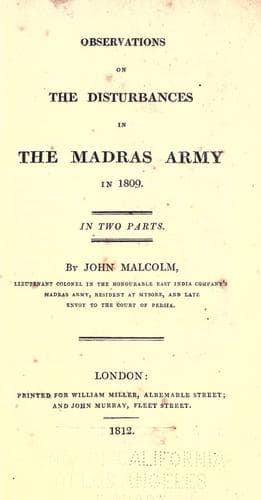
Observations on the Disturbances in the Madras Army in 1809Malcolm, John
History
Observations on the Disturbances in the Madras Army in 1809
Malcolm, John
India. Army -- History; Malcolm, John, 1769-1833
[10] I heard this plan mentioned by an officer high on the staff,
the day before I sailed for Masulipatam, and protested against its
principle, as directly contrary to that on which I had been desired
to act, and indeed to every effort of conciliation. The Governor, to
whom I immediately stated this fact, appeared to me to accord in my
opinion; but, a few days after my departure, he was induced to adopt
this measure, and to provoke disobedience to authority.
[11] The following are the sentiments of Colonel Close upon this
subject, as expressed in his letter to Major Barclay under date the
24th of July, 1809, and published in the correspondence laid before the
House of Commons:
"It is generally admitted as a sound maxim, not to hazard the giving
of an order unless there be a fair ground of presumption that it will
be obeyed. From the apparent circumstances of the time, the orders
sent to Masulipatam were perhaps fairly hazarded; but, after those
orders had been disobeyed, to send orders to Hyderabad for the march
of a battalion, might have been regarded as a measure in some degree
exceptionable. The officers, who have opposed the orders sent for
the purpose, are now more forcibly tied together than before. The
extreme of their proceedings is increased, and their danger and fear
seriously heightened. Their impulse to act is become more violent; and
accordingly the loss to the public cause must be in proportion to all
these augmentations. But this is not all. If the measure of moving the
battalion was meant to be useful, in having an experimental effect,
Hyderabad was assuredly the very place at which the experiment should
not have been made; confusion could not be so hurtful any where else."
Those who know the delicacy of this superior man will judge, from this
extract, what must have been the strength of his feelings upon the
subject.
[12] The trial of Lieutenant-Colonel Innes, and the removal from the
general staff of some officers obnoxious to the malecontents, were
among the demands in this paper.
[13] Lord Minto has, in his letter to the secret committee, noticed
this feeling, as forming a strong and operative principle of action in
the minds of these infatuated men.
[14] Vide Appendix.
[15] The names of the principal of these officers, Colonel Clarke,
Colonel Rumley, Colonel Floyer, Major Russel, and Captain Noble, will
be received by all parties as full evidence of the truth of this
assertion.
[16] July, 1809.
[17] Emissaries of a similar character were at and before this period
sent to all the native corps.
Public-domain text, read in full here on John Shaqi.
Reviews
Reviews
No reviews yet
Be the first to share your thoughts on this work.
Elsewhere in the archive
Join the Discussion
Join the discussion
Sign in to leave a comment or review.
Sign InorCreate an account