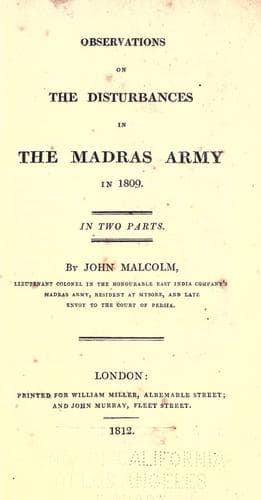
Observations on the Disturbances in the Madras Army in 1809Malcolm, John
History
Observations on the Disturbances in the Madras Army in 1809
Malcolm, John
India. Army -- History; Malcolm, John, 1769-1833
[18] Government could not have supposed men very deep in guilt, upon
whose solemn assurance that they would fulfil the obligation of their
commissions such reliance was to be placed. It was evident, that had
they cherished any serious designs against their country, or any of its
constituted authorities, they would not have hazarded the failure of
their schemes by stickling at the little additional guilt that would
have attended the breach of any test so forced upon their acceptance;
they would have signed, and watched the opportunity of accomplishing
their plans. But of this there was no apprehension: they were
acknowledged, at the moment this pledge was presented, to be men of
honour, and alive to all the obligations that word implies. And can it
be argued that men, with such feelings, were not to be fixed in their
duty, or reclaimed to it, by other means than such as _almost imposed
opposition as a point of honour_, as by it only they could avoid the
reproach of having been trepanned, alarmed, and coerced into a promise
to perform that duty which they owed to the state they served.
[19] Captain Moodie, the commanding officer, and almost all the
officers of the first battalion of the 6th regiment, were among this
number, though that corps had, up to this date, been remarkable for
never having joined in any one of the guilty or objectionable measures
of the army. It was a sense of their past conduct that made such
treatment more insufferable.
[20] The senior Company's officer at this meeting was Colonel Clarke,
commanding the artillery, who was known to be exempt even from
suspicion of any share whatever in the violent proceedings of a part
of the army, and had been recently selected on that ground to command
at the Mount. Was it not natural that a sense of his own conduct
should have led this honourable officer to reject with indignation a
proposition made in a mode so insulting to his feelings as a man and an
officer.
[21] To many of this class it must have been an agreeable release from
the rigid obligations of their commission. It offered a temporary
retirement from their duty to the state; and, in doing so, changed in
some degree the _character of that duty_. By signing the test they
became volunteers against men whose guilt they had to a certain extent
shared, and had no longer, to support their minds in so trying a
situation, that plea of indispensable necessity which their commission
imposed.
[22] This was the substance of the order that I recommended to be
issued at this period, the principle of which has been so arraigned by
the Government of Fort St. George. A copy of this order is inserted in
the Appendix.
Public-domain text, read in full here on John Shaqi.
Reviews
Reviews
No reviews yet
Be the first to share your thoughts on this work.
Elsewhere in the archive
Join the Discussion
Join the discussion
Sign in to leave a comment or review.
Sign InorCreate an account