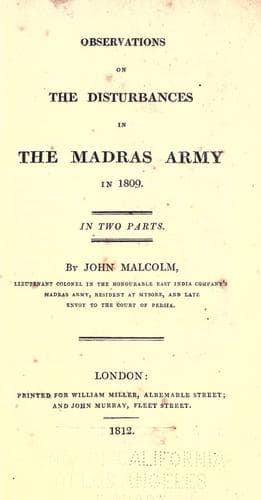
Observations on the Disturbances in the Madras Army in 1809Malcolm, John
History
Observations on the Disturbances in the Madras Army in 1809
Malcolm, John
India. Army -- History; Malcolm, John, 1769-1833
[23] I might fill a volume if I were to enter into any general
reasoning on the vital wound given to military subordination by this
measure. The relation of the private soldier to the subaltern has been
well termed the key-stone of the arch: an army may survive any other
change; but to disturb that relation, is to dissolve the whole: here
begins the obedience of the many to the few. In civil society, this
problem appears of difficult solution: but there, it is the obedience
of the dispersed and disarmed many; it is rare, and in well regulated
communities almost unfelt. In military bodies it is the hourly
obedience, even to death, of the armed and embodied many. The higher
links which bind subalterns to their superiors, and these to one chief,
are only the obedience of the few to the fewer, and these fewer to one.
These relations are easily intelligible. Honour, and obvious interest,
are sufficient to account for these: and any injury they sustain
can be repaired. But the obedience of the whole body of soldiers to
their immediate officers, is that which forms an army, and cannot be
disturbed without the utmost danger of total destruction. It was upon
this act of the French Assembly that Burke observed, "They have begun
by a most terrible operation; they have touched the central point,
about which particles that compose armies are at repose; they have
destroyed the principle of obedience in the great essential critical
link between the officer and the soldier, just where the chain of
military subordination commences, and on which the whole of that system
depends." Sir George Barlow, it has been forcibly remarked, could
discover no other mode of suppressing a _rebellion_ of officers than by
exciting a _mutiny_ of _soldiers_.
[24] 1794 and 1795.
[25] There can be no doubt of the truth of the observation which a
great and well-informed statesman formerly made upon this question.
"The European character in India" (Lord Melville observes in one of
his letters to the Court of Directors) "cannot be raised too high. If
the natives should be accustomed to look upon persons in the British
service with indifference and contempt, they will rapidly annihilate
our Empire there, and with it the very few Europeans by whom that
country is held in subjection." If this is true of Europeans in
general, and our Indian subjects, with what particular force must it
apply to the relations between the sepoy and his European commander?
Public-domain text, read in full here on John Shaqi.
Reviews
Reviews
No reviews yet
Be the first to share your thoughts on this work.
Elsewhere in the archive
Join the Discussion
Join the discussion
Sign in to leave a comment or review.
Sign InorCreate an account