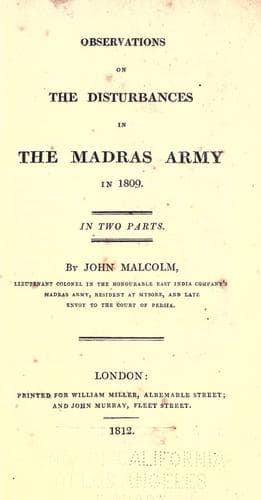
Observations on the Disturbances in the Madras Army in 1809Malcolm, John
History
Observations on the Disturbances in the Madras Army in 1809
Malcolm, John
India. Army -- History; Malcolm, John, 1769-1833
[26] The most violent even among the officers were so alarmed at the
evil this impression must produce to their country, that they carefully
avoided, till the last extremity, any mention of it to the natives
under their command: not, I am satisfied, from any fear of failing in
their efforts to debauch them from their duty, but from a deep sense
of the danger of such a communication: and those who believe that the
defeat of this confederacy through the means adopted will for ever
prevent the occurrence of a similar evil, should recollect, that it is
just as likely to have an opposite effect, and to render that evil, if
brought on by similar causes, far more dangerous. The European officers
may, in their next quarrel with their local Government, be taught
by this failure to league with the native officers, and to hold out
advantages to them that will secure their most zealous co-operation;
and such a conspiracy would lose India. It is dangerous even to hold an
opinion that this Empire can be preserved by any means but the action
of a wise, temperate, and just Government, which, though firm and
powerful, must rule its British subjects with the greatest attention to
those habits and principles which are, from the form and character of
the constitution under which they are born, inherent in their nature,
and which can never be disregarded or offended without a danger of
sedition or convulsion.
[27] As a proof of this, the following fact will suffice. At the
period the test was promulgated, a direct correspondence, in the
native language, was opened by the chief civil and military officers
of Government with the native officers. This was equally maintained
with those corps, the European officers of whom remained firm in their
duty, as others; and a respectable Company's officer, who had signed
the test, and was commanding a corps at Madras, (on his senior subahdar
bringing him letters of this description, which he had received,) made
a representation of the circumstance; but was reprimanded for doing so,
and told it was a general rule, from which it was not deemed proper to
make any deviation. If it had been desirable to make any communications
in the native languages to the men, such could assuredly have been
forwarded to the European officer in command, and the principles of
military discipline observed; but an observance of the general rule was
the point to which _importance was attached_, even in a case where the
operation was _admitted_ to be baneful, and consequently where the more
_limited_ that was, the better for the public interests.
[28] Burke.
[29] These are not sentiments formed on a contemplation of the result
of the disturbances. I presented a similar picture of their situation
to the deluded officers at Masulipatam, and circulated a letter
containing all the substance of these reflections to the army previous
to the occurrence of any deliberate opposition to Government. Vide
Appendix: Letter to Lieutenant-Colonel McLeod.
Public-domain text, read in full here on John Shaqi.
Reviews
Reviews
No reviews yet
Be the first to share your thoughts on this work.
Elsewhere in the archive
Join the Discussion
Join the discussion
Sign in to leave a comment or review.
Sign InorCreate an account