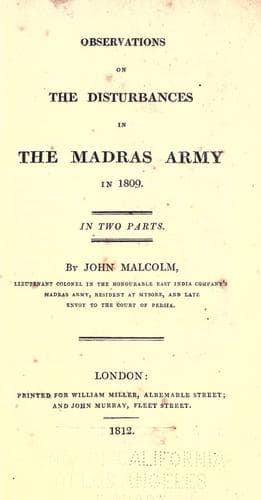
Observations on the Disturbances in the Madras Army in 1809Malcolm, John
History
Observations on the Disturbances in the Madras Army in 1809
Malcolm, John
India. Army -- History; Malcolm, John, 1769-1833
The only reply I received to this communication, was by a note from
Colonel Barclay, under date the 2d of August, to acquaint me, that,
for the reasons I had stated, "Sir George Barlow would not press me
to go to Mysore, and that it was the Governor's intention to reply
to the other parts of my letter at more leisure." He never, however,
condescended to make such a reply, or indeed to honour me with any
subsequent communication whatever, either personally, or through the
medium of any of his staff: and an event occurred sometime afterwards,
which produced such irritation upon his mind, as to make him deny me
the common civilities due to an officer in my public station. Some
time after my return to Madras, an address[65] from the inhabitants
of Madras to Sir George Barlow was drawn up, and sent in circulation.
This address was said to have originated with a staff officer of rank.
None of the usual forms of convening the inhabitants had taken place;
and the mode adopted to obtain signatures was still more extraordinary
than this glaring departure from common usage. Gentlemen of the first
respectability in the civil service informed me, that when they had
testified an aversion to sign this address unless parts of it were
modified, they had received such plain intimations regarding the
consequences with which their refusal would be attended, as left them
in no doubt but that they must either sacrifice their opinions, or
bring immediate distress, and perhaps final ruin, upon themselves
and their families. Under these circumstances some had signed; while
others had actually absented themselves for days from their own houses,
to escape the painful importunities to which they were exposed. It
is necessary here to state, that almost all ranks were ready at this
moment to come forward with a public declaration of duty and attachment
to Government, and of their readiness to sacrifice their lives and
fortunes in its defence; but a strong objection was entertained by many
to that part of the circulated address which cast reflections upon
that body of officers who had embraced the alternative of retiring for
a period from their duty, rather than sign the test which Government
had proposed. It was said, and with great truth, that at the moment
when Government professed its desire to reclaim these officers to a
more active allegiance, nothing could be more unwise and useless than
exasperating their minds to a sullen perseverance in error, by an abuse
of them in an address signed by a few civil and military inhabitants
of Madras; and that it was perfectly evident such an expression of
sentiment could only have the effect of widening a breach it was most
desirable to close, and of creating (by exciting discussion) further
dissensions and difference of opinion among those of whose devoted
attachment to Government there could be no doubt. Such were my own
sentiments regarding this address: and while I foresaw the mischief it
Public-domain text, read in full here on John Shaqi.
Reviews
Reviews
No reviews yet
Be the first to share your thoughts on this work.
Elsewhere in the archive
Join the Discussion
Join the discussion
Sign in to leave a comment or review.
Sign InorCreate an account