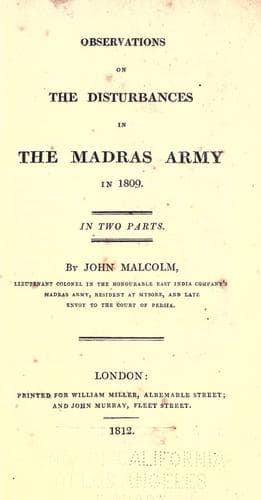
Observations on the Disturbances in the Madras Army in 1809Malcolm, John
History
Observations on the Disturbances in the Madras Army in 1809
Malcolm, John
India. Army -- History; Malcolm, John, 1769-1833
was calculated to produce, I could divine no possible good from its
agitation. It was sent for my signature, with the following note from
Colonel Leith:
"The accompanying address is submitted to Lieutenant-Colonel Malcolm
for his consideration, which, as soon as he is done with, it is
requested he will return to the bearer."
To this I immediately sent an answer, as follows:
"Lieutenant-Colonel Malcolm returns the address to Lieutenant-Colonel
Leith. He has not signed it, for reasons very foreign to any want of
respect and regard for Sir George Barlow, or of duty, obedience, and
attachment to that constituted authority of his country under which he
is placed."
I cannot recollect that I ever in my life took a step in which my mind
was more decided respecting its propriety, on every public and private
principle, than upon this occasion. I considered the address, both from
the irregular mode in which it was brought forward, the unbecoming
means resorted to in order to obtain signatures, and the expressions
contained in it, as an unwise measure, which had originated in that
spirit of undistinguishing violence which I conscientiously believed
had been the chief means of producing a crisis that this act was
calculated to inflame. It did not appear to my mind to be attended with
the slightest benefit, for it brought no new friends to Government:
and though it could not shake the attachment to the legitimate
authority of their country of any persons whose principles were fixed,
its tendency was to excite jealousy and division among those who were
most warmly attached to order and Government: and among these, however
actuated by a sense of public duty, it was natural that a difference
of _private opinion_ should exist. Some were, no doubt, more disposed
than others to approve violent and unqualified proceedings, or perhaps
less disposed to maintain that independence of mind which no man should
ever be censured for maintaining upon such points; otherwise addresses
of this stamp would not only lose their value, but become tests of
the most odious and invidious nature that a tyrannic Government could
invent, to degrade or alienate the minds of its subjects.
I certainly was most reluctant to believe that this measure had Sir
George Barlow's sanction: it seemed to me of a character opposite to
all the principles and habits of his life: nor could I forget those
grounds which he had assumed when he recently refused to permit me
to frame an address of a very opposite tendency, and one that would,
in all probability, have prevented those evils which this seemed
calculated to inflame. I never was more surprised than when (some
days subsequent to my note to Colonel Leith) I was informed by a
confidential officer of the Governor's staff, to whom I mentioned what
I had done, and the reasons by which I was actuated, that the address,
from the first, had the Governor's complete sanction and approbation.
Public-domain text, read in full here on John Shaqi.
Reviews
Reviews
No reviews yet
Be the first to share your thoughts on this work.
Elsewhere in the archive
Join the Discussion
Join the discussion
Sign in to leave a comment or review.
Sign InorCreate an account