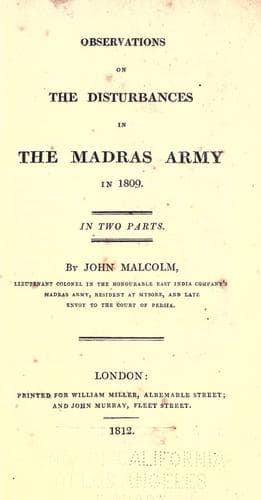
Observations on the Disturbances in the Madras Army in 1809Malcolm, John
History
Observations on the Disturbances in the Madras Army in 1809
Malcolm, John
India. Army -- History; Malcolm, John, 1769-1833
In closing this subject, it may be necessary to state, that this
address, after all the unbecoming efforts that were used to obtain
signatures, had only fifty-seven names affixed to it; among which,
twenty-four only were civilians and inhabitants of Madras: the
remainder were officers of his Majesty's service, with a few of the
staff of the Company's army. If all those who did not sign it were
not actually considered as disaffected, they were deemed by those
whom this measure had formed into a party, as lukewarm in the public
cause. This species of injustice is too common to such times, to
afford any individual a right of complaint; but there should be a
difference between the momentary feeling of a violent party during a
period of commotion, and the deliberate sentiments of a public ruler.
I have already mentioned, that the crime of having presumed, though
in the most respectful manner, to act conformably to the dictates
of my own judgment on a question which was referred to me as a
private individual, subjected me, at the moment, to the loss of those
civilities from Sir George Barlow to which I had a right from my public
station; and I did not require the evidence I have now obtained, from
the publication of the letter from the Government of Madras to the
Secret Committee, to satisfy my mind that my character has since had to
war with all the weight that belongs to the influence and opinion of
Sir George Barlow: but, great as this odds may appear to many, it can
excite no apprehension in a mind fortified as mine is by a conscious
sense of never having deviated from the path of private rectitude, or
public duty.
Though, subsequent to this transaction, all personal intercourse
between Sir George Barlow and me had ceased, I could not look with
indifference on the events that occurred; and when the mad desperation
of the officers of the two corps which marched from Chittledroog to
proceed to Seringapatam led to an action, I thought the opportunity
favourable to close this horrid scene in a manner every way suited to
the dignity of Government. I first communicated my sentiments upon this
point to Lieutenant-Colonel Barclay, and afterwards ventured to address
the following note to Sir George Barlow, expecting that the importance
of the subject, and a consideration of former acquaintance and regard,
would at least obtain a pardon for such a liberty.
"DEAR SIR,
Public-domain text, read in full here on John Shaqi.
Reviews
Reviews
No reviews yet
Be the first to share your thoughts on this work.
Elsewhere in the archive
Join the Discussion
Join the discussion
Sign in to leave a comment or review.
Sign InorCreate an account