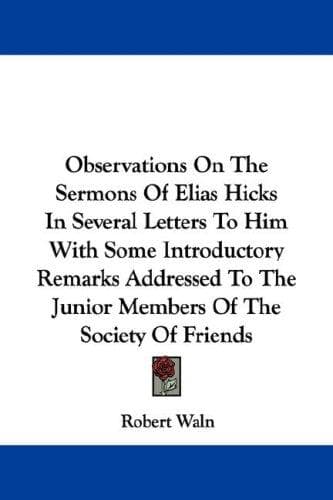
Observations on the Sermons of Elias Hicks: In Several Letters to Him; With Some Introductory Remarks, Addressed to the Junior Members of the Society of Friends. — John Shaqi
Observations on the Sermons of Elias Hicks: In Several Letters to Him; With Some Introductory Remarks, Addressed to the Junior Members of the Society of Friends.Waln, Robert
Religion
Observations on the Sermons of Elias Hicks: In Several Letters to Him; With Some Introductory Remarks, Addressed to the Junior Members of the Society of Friends.
Waln, Robert
Hicks, Elias, 1748-1830; Society of Friends -- Hicksite controversy
You say, that in denying the power of the spirit to _beget_, you did not
mean to question the power to _create_. To limit is to destroy the
omnipotency of the Creator; and when we see such a creature as man,
presuming to scan His power and determine what He can, or cannot do, the
feelings which its profanity would otherwise occasion, are lost in our
astonishment at its arrogance and presumption. But you have announced
your opinion not only as sanctioned by divine inspiration, but as being
according to "the true analogy of reason," and yet, taken with your
subsequent explanation, it is enveloped in absurdity. In admitting the
power to create, you have destroyed your own argument; for you cannot
suppose that there was an individual present in the meeting, so grossly
dull as to believe that when the prophecy was accomplished in the birth
of our Saviour, it was by the means which your explanation points to; or
that it was other than a miraculous intervention of that merciful Being,
who in his unlimited power and inscrutable wisdom, has chosen his own
way in directing us to a knowledge of those truths which the gospel
unfolds. And if we assent to your doctrine in the restricted sense in
which you say you intended the word _beget_ to be understood; we must
believe there are sexes in spirit, and that it can only be produced by a
corporeal union of incorporeal beings.
Here is no proof of your ability to draw conclusions from the _analogy
of reason_, but it is a striking illustration of the wisdom of the
counsel, "not to multiply words without knowledge."
A very keen and accurate observer of the foibles and infirmities of man
remarks, "it would be well, if people would not lay so much weight on
_their own reason_ in matters of religion, as to think every thing
impossible and absurd, which they cannot conceive: how often do we
contradict the right rules of reason in the whole course of our lives?
_Reason_ itself is true and just, but the reason of every particular man
is weak and wavering, perpetually swayed and turned by his interests,
his passions, and his vices."[6]
Footnote 6:
Swift.
Public-domain text, read in full here on John Shaqi.
Reviews
Reviews
No reviews yet
Be the first to share your thoughts on this work.
Join the Discussion
Join the discussion
Sign in to leave a comment or review.
Sign InorCreate an account