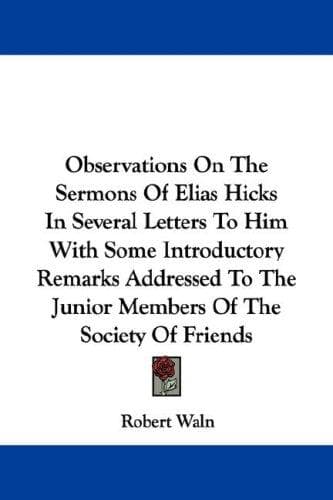
Observations on the Sermons of Elias Hicks: In Several Letters to Him; With Some Introductory Remarks, Addressed to the Junior Members of the Society of Friends. — John Shaqi
Observations on the Sermons of Elias Hicks: In Several Letters to Him; With Some Introductory Remarks, Addressed to the Junior Members of the Society of Friends.Waln, Robert
Religion
Observations on the Sermons of Elias Hicks: In Several Letters to Him; With Some Introductory Remarks, Addressed to the Junior Members of the Society of Friends.
Waln, Robert
Hicks, Elias, 1748-1830; Society of Friends -- Hicksite controversy
This impatience of control is increased by a ranting spirit which seems
of late to have infected a portion of the society, and which, in its
consequences, is always more injurious than infidelity itself; and
generally arises from a restlessness of disposition, which not content
with the measure of light which may have been imparted, is always
aspiring after greater things. It arises from a desire after
distinction; and as this disposition must prevent a growth in genuine
religion, the delusions of self-love easily enable a man to substitute
his own imaginations for revelations; and as every passion is
strengthened by indulgence, he proceeds from one step to another, until
he fancies himself under the constant and peculiar guidance of the
spirit, not only in his religious duties, but in all the temporal
concerns of life. It naturally follows, that when he has persuaded
himself that he is thus gifted and endowed, he will feel himself above
the advice of men, and regard all regulations which may have a tendency
to restrain his wanderings, as obstructing him in his duties, and it
will be one of his favourite objects to relieve himself from all
control. How individuals actuated by such passions can subject the minds
of others to their illusions, would indeed be wonderful, did not history
furnish sufficient proof that it is difficult to calculate too largely
on the credulity of a portion of mankind.
Whenever this disposition of mind is discovered, especially in any part
of the ministry, every reflecting member of society must perceive the
necessity of adopting means to prevent the injurious consequences of it;
and as that duty more especially devolves on the elders, (who are, and
always have been, the true and efficient support of the society,) they
soon become objects of dislike to the sublimated spirits opposed to
them, and the diminution of their power and authority, the first and
favourite scheme.
That they will not succeed, I am fully persuaded; because I think it
must be evident to every unclouded mind, that without such salutary
interference as they often find it necessary to exercise, all order and
propriety would be banished from the society.
Cunning is not more inconsistent with fanaticism, than it is with
lunacy; for however perverted the mind may be in relation to particular
subjects, we often see individuals in both situations, adopting the most
plausible means for the accomplishment of the most irrational objects.
It is not therefore to be expected that any attempts will be made
totally to abolish the eldership: such a proposal would hardly be
successful; but if means are found to render that body less independent,
and to diminish the weight and authority which they have long and
deservedly possessed, it may subserve the cause, and lead to ultimate
success in their projects: and here, if any where, the danger seems to
be.[1]
Footnote 1:
Public-domain text, read in full here on John Shaqi.
Reviews
Reviews
No reviews yet
Be the first to share your thoughts on this work.
Join the Discussion
Join the discussion
Sign in to leave a comment or review.
Sign InorCreate an account