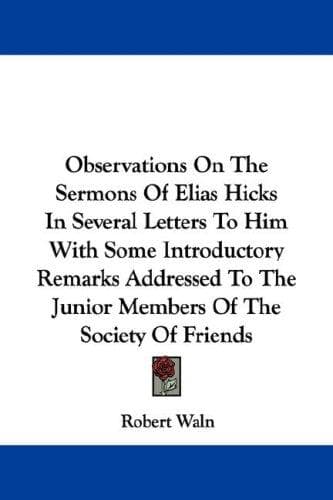
Observations on the Sermons of Elias Hicks: In Several Letters to Him; With Some Introductory Remarks, Addressed to the Junior Members of the Society of Friends. — John Shaqi
Observations on the Sermons of Elias Hicks: In Several Letters to Him; With Some Introductory Remarks, Addressed to the Junior Members of the Society of Friends.Waln, Robert
Religion
Observations on the Sermons of Elias Hicks: In Several Letters to Him; With Some Introductory Remarks, Addressed to the Junior Members of the Society of Friends.
Waln, Robert
Hicks, Elias, 1748-1830; Society of Friends -- Hicksite controversy
In this instance Paul was recommending a rule of conduct, and ought to
be allowed to speak for himself: so thought Robert Barclay, and in
accounting for the exhortation he has given the probable reason of it.
He considered it neither as an allegory or a figure; but he had not
arrived at that degree of spiritual knowledge which enabled him to
discover in every page of the Bible a meaning in direct contradiction to
the plain and obvious sense of the written language. Religion was with
him not an occult science, nor the Bible a caballistick book which can
never be read to advantage until the truths contained in it have been
previously revealed to us.[41] On the contrary, he believed with the
Apostle Paul "that these things were written for our learning," that
"the holy scriptures are able to make wise unto salvation, through faith
which is in Christ Jesus," and that "all Scripture is given by
inspiration of God, and is profitable for doctrine, for reproof, for
correction, for instruction in righteousness, that the man of God may be
perfect, thoroughly furnished unto every good work."[42]
Footnote 41:
Sermons, p. 313.
Footnote 42:
2nd Timothy, Chap. 3d.
LETTER VII.
When the early Quakers, dissatisfied with the formal worship of the
existing protestant church, separated themselves and formed a society of
their own, they were reproached by some with denying the authenticity of
the sacred writings, and by others with setting up their own
inspirations in opposition to them; and they seem at an early period to
have discovered the necessity of recording their belief on this subject,
not only to refute the calumnies circulated by their opponents, but as a
guide to the inexperienced of their own sect. For, such was the ferment
of men's minds at that moment, and the violence of the change from the
dull uniformity of formal belief, to all the extravagancies of
unrestrained enthusiasm, that it appeared like an epidemic affecting all
descriptions of people; and their imaginations became so exalted, that
every fancy was mistaken for a revelation, and every preacher, however
wild his doctrines, had his followers. Nor did their own members wholly
escape the infection; for with all their care, there were those among
them who indulged in extravagancies, to the great grief of their more
sober friends.
Public-domain text, read in full here on John Shaqi.
Reviews
Reviews
No reviews yet
Be the first to share your thoughts on this work.
Join the Discussion
Join the discussion
Sign in to leave a comment or review.
Sign InorCreate an account