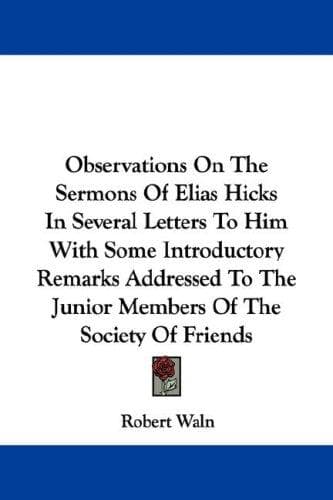
Observations on the Sermons of Elias Hicks: In Several Letters to Him; With Some Introductory Remarks, Addressed to the Junior Members of the Society of Friends.Waln, Robert
Religion
Observations on the Sermons of Elias Hicks: In Several Letters to Him; With Some Introductory Remarks, Addressed to the Junior Members of the Society of Friends.
Waln, Robert
Hicks, Elias, 1748-1830; Society of Friends -- Hicksite controversy
Socrates alone, of all the ancient philosophers, had adopted the belief
of a future state of rewards and punishments; and the reason why he
arrived at this truth, affords an instructive lesson to the metaphysical
preachers of the present day--he confined himself to the study of
morality. "What, (says an eminent writer,) could be the cause of his
belief, but this restraint, of which his belief was the natural
consequence? For, having confined himself to morals, he had nothing to
mislead him; whereas, the rest of the philosophers, applying themselves
with a kind of fanaticism to physics and metaphysics, had drawn a number
of absurd but subtile conclusions, which directly opposed the
consequences of those moral arguments."[64]
Footnote 64:
Warburton.
And the great Newton, in reference to this subject, finishes his
principles of natural philosophy with these reflections:--"This most
elegant frame of things could not have arisen, unless by the contrivance
and direction of a wise and powerful being: and if the fixed stars are
the centres of systems, these systems must be similar; and all these,
constructed according to the same plan, are subject to the government of
_one_ Being. All these he governs, _not as the soul of the world_, but
as the Lord of all; and therefore, on account of his government, he is
called the Lord God; for God is a relative term, and refers to subjects.
Deity is God's government, not of his own body, as those think who
consider him as the soul of the world, but of his servants. The supreme
God is a _Being_, eternal, infinite, and absolutely perfect. But a
being, however perfect, without government is not God; for we say my
God, your God, the God of Israel. We cannot say my Eternal, my Infinite.
We may have some notions, indeed, of his attributes, but can have none
of his nature. With respect to bodies, we see only shapes and colour,
hear only sounds, touch only surfaces. These are attributes of bodies,
but of their essence we know nothing. As a blind man can form no notion
of colours, we can form none of the manner in which God perceives, and
understands, and influences every thing.
"Therefore, we know God only by his attributes. What are these? The wise
and excellent contrivance, structure, and final aim of all things. In
these his perfections we admire him, and we wonder. In his direction or
government, we venerate and worship him--we worship him as his servants;
for God without dominion, without providence, and final aims, is
_Fate_--not the object either of reverence, of hope, of love, or of
fear."
Public-domain text, read in full here on John Shaqi.
Reviews
Reviews
No reviews yet
Be the first to share your thoughts on this work.
Join the Discussion
Join the discussion
Sign in to leave a comment or review.
Sign InorCreate an account