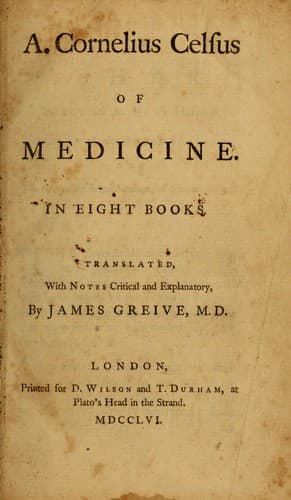
Of Medicine, in Eight BooksCelsus, Aulus Cornelius
History
Of Medicine, in Eight Books
Celsus, Aulus Cornelius
Medicine, Greek and Roman
That kind of distemper, which by the Greeks is called cardiacus[BH],
is directly contrary to the last mentioned; although phrenitic people
often fall into it: for the mind in that is disordered, in this it is
sound. This is nothing else but an excessive weakness of the body;
which from a languishing stomach is dissipated by immoderate sweating.
And one may immediately know that this is the disease, when the
pulsations of the arteries are small and weak, and sweat uncommon both
in degree and continuance, breaks out from the whole breast, and neck,
and even from the head, the feet only and legs being more dry and cold.
This distemper is of the acute kind.
[BH] καρδιακὸς.
The first step in the cure is to apply restringent cataplasms to the
præcordia; the second to restrain the sweat. That is accomplished by
bitter oil, or that of roses, or quinces, or myrtles. With any of these
the body is to be gently anointed; and then a cerate of some one of
them is to be applied.
If the sweat nevertheless prevails, the person is to be rubbed over
with gypsum, or litharge, or Cimolian chalk, or to be sprinkled now
and then with the powder of these. The same purpose is answered by the
powder of dry myrtle or bramble-leaves, or the dried lees of austere
and strong wine. And there are a great many more things of the same
nature, which if they cannot be had, sprinkling of common dust will
have a good effect. And besides these, that the body may sweat less,
the person ought to be covered with a light garment, and set in a place
not hot, with the windows open, so that he may be even sensible of the
stream of air.
The third remedy is to succour the weakness of the patient by eating
and wine. Food is not to be given in great quantity indeed, but often,
both in the night and day; so as it may nourish, and not load. It
ought to be of the weakest kind, and agreeable to the stomach: and
unless there be a necessity, we ought not to be in haste to give wine.
If there is reason to fear the person is fainting, then both intrita
with wine, and wine itself, austere but small, and somewhat diluted,
with the cold taken off it, may be given pretty frequently and freely;
with the addition of polenta(20), provided the patient takes little
food. And the wine ought to be neither very weak nor very strong: and
the patient in a day and a night may very well drink two or three
heminæ; if it be a person of a large make, even more: if he has no
appetite for food, it is fit first to anoint him, then to pour cold
water all over him, and then give it him.
Public-domain text, read in full here on John Shaqi.
Reviews
Reviews
No reviews yet
Be the first to share your thoughts on this work.
Elsewhere in the archive
Join the Discussion
Join the discussion
Sign in to leave a comment or review.
Sign InorCreate an account