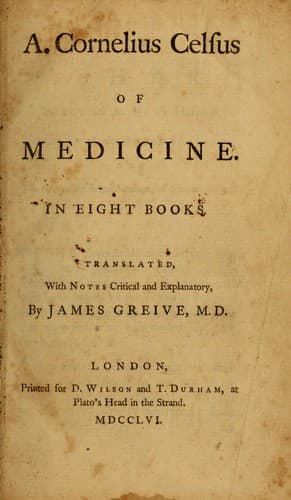
Of Medicine, in Eight BooksCelsus, Aulus Cornelius
History
Of Medicine, in Eight Books
Celsus, Aulus Cornelius
Medicine, Greek and Roman
In this country we _sometimes_, _though_ rarely see apoplectic people,
who are stupified both in body and mind. It happens sometimes from
being thunderstruck, sometimes from a distemper. The last case the
Greeks call apoplexia[BV]. Such people must be bled. And either white
hellebore be made use of, or a clyster given. Then friction is to be
applied; and food taken of the middle kind, by no means fat; some of
the acrid kinds too; and wine must be refrained.
[BV] ἀποπληξία.
CHAP. XXVII.
OF THE PALSY, AND ITS CURE.
But a relaxation of the nerves is a distemper every where common.
But sometimes it attacks the whole body, sometimes particular parts.
Ancient authors called the first apoplexia, the other paralysis: now
I observe the name of paralysis is given to both. And it is common
for those, who have all their limbs extremely relaxed, to be quickly
carried off. And if they are not snatched away, they live indeed for
some time, but yet seldom recover their health; and for the most part
draw out a miserable life, with the loss of their memory too. When
it is partial, it is sometimes an acute distemper, often chronic,
generally incurable.
If all the limbs are greatly affected, bleeding either kills or cures.
Any other method scarcely ever restores health; often only delays
death; in the mean time renders life uneasy. After bleeding, if both
motion and the judgment don’t return, there is no hope left: if they do
return, there is a prospect of recovery.
But where a particular part is relaxed, either blood is to be let, or
a clyster administered, according to the strength of the body and the
distemper. All the other methods to be pursued are the same in both
cases. For the principal thing is to avoid cold: and the patient must
return gradually to exercise, so as immediately to apply to walking,
if he can. If the weakness of his legs be too great for that, he
may either use gestation, or be agitated by moving his bed _to and
fro_: then that member, which is diseased, may be moved of itself if
possible; if that cannot be done, let another person move it, and so
return it to its ordinary habit by a kind of force. It does good also
to irritate the skin of the benumbed limb, either by beating it with
nettles, or keeping mustard upon it, till the part begins to grow
red; when they may be removed. Bruised squills likewise, or bulbous
roots bruised with frankincense, are proper applications. Neither is
it amiss, to vellicate the skin with resin for some time every third
day, and that in several places; and sometimes to make use of cupping
without scarification. Old oil is fittest for unction, or nitre mixed
with vinegar and oil. Further, it is highly necessary to foment with
warm sea-water; or if that is not to be got, with salt-water at least.
And if any where there is a natural or artificial place for swimming
in this kind of water, by all means to make use of it; and the limbs,
which are most disordered, are to be principally agitated there.
Public-domain text, read in full here on John Shaqi.
Reviews
Reviews
No reviews yet
Be the first to share your thoughts on this work.
Elsewhere in the archive
Join the Discussion
Join the discussion
Sign in to leave a comment or review.
Sign InorCreate an account