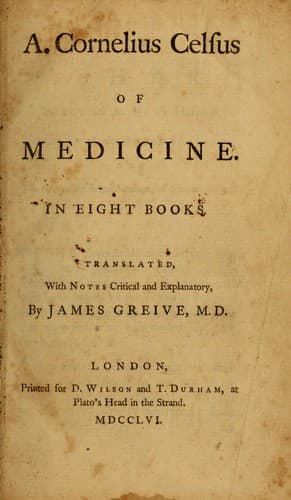
Of Medicine, in Eight BooksCelsus, Aulus Cornelius
History
Of Medicine, in Eight Books
Celsus, Aulus Cornelius
Medicine, Greek and Roman
It is very proper to let blood in this disorder. If it is not removed
by this, to give a clyster. If it does not yield even to that, to
vomit by white hellebore. Besides it is necessary to avoid the heat of
the sun, fatigue, and wine. But if it is not cured by these methods,
running must be used, and gentle and long friction upon that part,
which is diseased; in the other parts shorter, but brisk. It does
service also to procure sneezings, to shave the head, and to pour upon
it hot, either sea water, or at least salt water, with sulphur added
to it: after this bathing, to rub again, to chew mustard, and at the
same time to apply cerate to the parts of the face that are affected,
and to the sound parts mustard, till it corrode them. The most proper
diet is of the middle kind.
[Sidenote: _Of a palsy of the tongue._]
But if the tongue be paralytick, which sometimes happens of itself,
sometimes is occasioned by distemper, so that the pronunciation is
indistinct; it is necessary to use a gargarism of a decoction of thyme,
or hyssop, or catmint; to drink water; to rub briskly the head, mouth,
and the parts under the chin, and the neck; to rub the tongue itself
with laser; to chew the most acrid things, such as mustard, garlick,
onion; to make strong efforts to articulate words clearly; to take
exercise, keeping in the breath; to pour cold water upon the head
often; sometimes to eat plentifully of radishes, and then to vomit.
[Sidenote: _Of a catarrh and gravedo._]
A humour distils from the head sometimes into the nose, which is a
slight disorder; sometimes upon the fauces, which is worse; sometimes
even upon the lungs, which is worst of all. If it have fallen upon
the nose, a thin rheum flows from the nostrils, the head is slightly
pained, a weight is felt in it, and there are frequent sneezings. If
upon the fauces, it irritates them, and raises a slight cough. If upon
the lungs, beside the sneezings and cough, there is also a weight in
the head, lassitude, thirst, heat, and bilious urine.
Another (though not very different) disorder is a gravedo. This
obstructs the nostrils, blunts the voice, raises a dry cough: at the
same time the saliva is salt, there is a sounding in the ears, the
veins of the head move, and the urine is turbid. All these disorders
Hippocrates calls coryzæ[CF]. I observe that this is now by the
Greeks appropriated to the gravedo: and catarrhs are called by them
catastagmi[CG]. These are common, and of short continuance; but if they
be neglected, are usually lasting. None of them is dangerous, but such
as ulcerate the lungs.
[CF] κορύζαι.
[CG] κατασταγμοὶ.
Public-domain text, read in full here on John Shaqi.
Reviews
Reviews
No reviews yet
Be the first to share your thoughts on this work.
Elsewhere in the archive
Join the Discussion
Join the discussion
Sign in to leave a comment or review.
Sign InorCreate an account