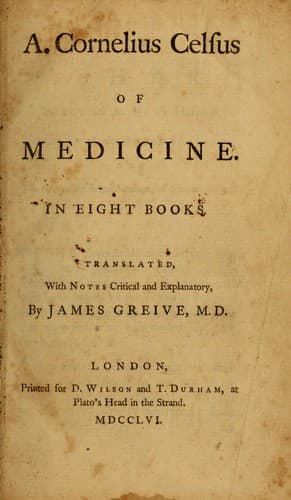
Of Medicine, in Eight BooksCelsus, Aulus Cornelius
History
Of Medicine, in Eight Books
Celsus, Aulus Cornelius
Medicine, Greek and Roman
If again they are round, which chiefly molest children, both the same
medicines may be given, and something more gentle, as the seed of
nettles powdered, or of cabbage, or cummin with water, or mint with the
same, or a decoction of wormwood, or hyssop in hydromel, or the seed
of cresses powdered with vinegar. It is good also to eat lupines, and
garlick, or to have clysters of oil administered.
CHAP. XVIII.
OF A TENESMUS, AND ITS CURE.
There is also another distemper, which is more mild than any I have
been treating of, called by the Greeks tenesmus[DE]. This ought to
be ranked neither with the acute nor the chronic disorders, since it
may be easily removed, and by itself never proves mortal. In this, as
well as in a dysentery, there is a frequent motion to stool; and equal
pain, when any thing is excreted. Something like to phlegm and mucus
is discharged, sometimes too, slightly tinctured with blood; but with
these is sometimes mixed what has been duly concocted from the food.
[DE] τεινεσμὸς.
It is proper to sit down in warm water; to apply something to the anus
itself pretty often. For which purpose many medicines are suitable:
butter with oil of roses; acacia dissolved in vinegar; that plaister,
which the Greeks call tetrapharmacum(29), melted with rose oil;
alum wrapped in wool, and thus applied; and the same injections which
relieve in the dysentery; the same decoction of vervains to foment the
lower parts. Every other day, water and light austere wine are to be
drunk alternately. The drink ought to be egelid, and nearer to cold:
the diet of the same nature as we have directed for a dysentery.
CHAP. XIX.
OF A SIMPLE PURGING, AND ITS CURE.
A purging, while recent, is still a more gentle distemper, in which the
discharge is both liquid, and more frequent than ordinary. In this the
pain is sometimes tolerable, at other times very severe; and that shews
a greater violence of the disease. But for the belly to be loose for
one day is often salutary; and even for several days, provided there be
no fever, and it cease in seven days. For thus the body is cleansed;
and what would have hurt internally, is advantageously evacuated.
But the continuance of it is dangerous; for sometimes it brings on a
dysentery, and febriculas, and wastes the strength.
Public-domain text, read in full here on John Shaqi.
Reviews
Reviews
No reviews yet
Be the first to share your thoughts on this work.
Elsewhere in the archive
Join the Discussion
Join the discussion
Sign in to leave a comment or review.
Sign InorCreate an account