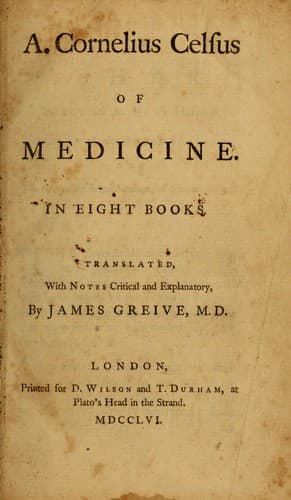
Of Medicine, in Eight BooksCelsus, Aulus Cornelius
History
Of Medicine, in Eight Books
Celsus, Aulus Cornelius
Medicine, Greek and Roman
Having gone through those disorders of the body, which are principally
relieved by diet, we must now proceed to that branch of physic, which
depends more upon medicines. The ancient authors put great confidence
in them; so did Erasistratus, and those, who stiled themselves
empiricks. Their efficacy was still more extolled by Herophilus and his
followers; insomuch that they attempted to cure no distemper without
them. They have written a great deal too concerning the virtues of
medicines: such are the treatises of Zeno, or Andreas, or Apollonius,
who was sirnamed Mus. Not without reason Asclepiades in a great
measure laid aside the use of them: and because almost all medicines
offend the stomach, and afford bad juices, he chose to apply all his
care to the management of the diet. But though this be more useful in
most distempers, yet many disorders are incident to our bodies, which
cannot be totally removed without medicines. It is fit to observe in
the first place, that all the branches of medicine are so connected
together, that they cannot be entirely separated; but each derives its
appellation from that, which is principally made use of in it. And
therefore as that, which cures by diet, sometimes employs medicines; so
the other, which chiefly works by medicines, ought also to take in the
diet, which is of great service in all disorders of the body. But since
all medicines have some peculiar powers, and often give relief single,
often mixed, it seems not improper first of all to mention both their
names and virtues, and the compositions of them; that our work may be
shortened, when we come to the curative part.
CHAP. I.
MEDICINES FOR STOPPING BLOOD.
A bleeding is stopped by copperas, which the Greeks call
chalcanthus[DG], chalcitis(1), acacia, lycium with water,
frankincense, aloes, gum(2), calcined lead(3), leeks, blood herb,
either Cimolian, or potter’s chalk, misy(4), cold water, wine,
vinegar, allum(5), melinum(6), scales both of iron(7) and copper;
and of this last there are two species, the one of common copper, the
other of red copper.
[DG] χάλκανθος.
CHAP. II.
AGGLUTINANTS AND RESTRINGENTS.
A wound is agglutinated by myrrh, frankincense, gum, especially
acanthine, fleawort, tragacanth, cardamom, bulbusses, lintseed,
cresses, white of an egg, glue, isinglass, the white vine(8), snails
bruised with their shells, boiled honey, sponge squeezed out of cold
water or wine or vinegar; or sordid wool dipped in the same, if the
wound be slight; also cobwebs.
Both scissile alum, which is called schiston[DH] and the liquid are
restringent, also melinum, orpiment, verdigrease, chalcitis, copperas.
[DH] σχιστὸν.
CHAP. III.
MEDICINES FOR PROMOTING A SUPPURATION.
Maturating and suppurating medicines are nard, myrrh, costus, balsam,
galbanum, propolis(9), storax, both the soot of frankincense(10)
and its bark, bitumen, pitch, sulphur, resin, suet, fat, and oil.
CHAP. IV.
MEDICINES FOR OPENING WOUNDS.
Public-domain text, read in full here on John Shaqi.
Reviews
Reviews
No reviews yet
Be the first to share your thoughts on this work.
Elsewhere in the archive
Join the Discussion
Join the discussion
Sign in to leave a comment or review.
Sign InorCreate an account