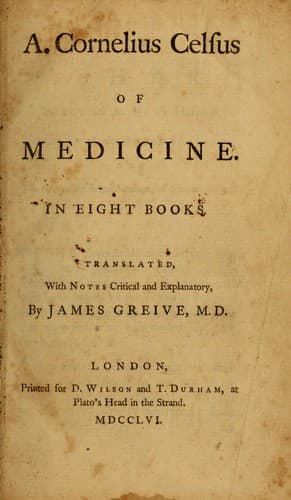
Of Medicine, in Eight BooksCelsus, Aulus Cornelius
History
Of Medicine, in Eight Books
Celsus, Aulus Cornelius
Medicine, Greek and Roman
Wounds are opened like mouths in bodies, which in Greek is called
anastomoun[DI], by cinnamon, balsam, panaces, long cyperus,
penny-royal, white violet flowers, bdellium, galbanum, turpentine
and pine resin, propolis, old oil, pepper, pellitory, ground pine,
stavesacre, sulphur, alum, seed of rue.
[DI] ἀναστομο̃υν. This word Celsus here translates literally _to
open like a mouth_.
CHAP. V.
CLEANSERS.
Cleansers are verdigrease, orpiment, which by the Greeks is called
arsenicon[DJ] (this in all respects has the same properties with
sandarach(11), but is stronger) copper scales, pumice, iris, balsam,
storax, frankincense, incense bark, both pine and turpentine resin
liquid, flower of the wild vine, lizard’s dung, blood of a pigeon,
and ring-dove, and swallow, ammoniacum, bdellium (which has the same
virtues with the ammoniacum, but is not so strong) southern-wood, dry
figs, gnidian berry(12), shavings of ivory, omphacium(13), radish,
the coagulum of blood, but especially that of a hare (which has the
same properties of others, but in this case is more efficacious)
ox gall, raw yolk of an egg, hartshorn, glue, crude honey, misy,
chalcitis, saffron, stavesacre, litharge, galls, copper scales(14),
blood-stone, minium, costus, sulphur, crude pitch, suet, fat, oil, rue,
leeks, lentils, vetches.
[DJ] ἀρσενικὸν.
CHAP. VI.
CORRODING MEDICINES.
Corrosives are liquid alum, but more especially the round, verdigrease,
chalcitis, misy, copper scales, especially of the red kind, calcined
copper(15), sandarach, minium from Sinope, cassia, balsam, myrrh,
incense bark, galbanum, liquid turpentine resin, both kinds of
pepper, but chiefly the round, cardamom, orpiment, lime, nitre, and
aphronitre(16), seed of smallage, narcissus-root, omphacium, bastard
sponge, oil of bitter almonds, garlic, crude honey, wine, mastich-tree,
iron scales, ox-gall, scammony, stavesacre, cinnamon, storax, seed of
rue, resin, seed of narcissus, salt, bitter almonds, as well as their
oil, copperas, chrysocolla(17), calcined shells.
CHAP. VII.
EATING MEDICINES.
The medicines, which eat flesh, are the juice of acacia, ebony,
verdigrease, copper scales, chrysocolla, Cyprus ashes(18), nitre,
cadmia(19), litharge, hypocistis(20), diphryges(21), salt,
orpiment, sulphur, rocket, sandarach, salamander(22), bastard sponge,
flour of copper(23), chalcitis, copperas, ochre, lime, vinegar,
galls, alum, milk of the wild fig-tree, or of sea spurge, which by the
Greeks is called tithymallus[DK], animal gall, soot of frankincense,
spodium(24), lentil, honey, olive-leaves, horehound, blood-stone, and
the Phrygian(25), and Asian, and Scissile(26) stones, misy, wine,
and vinegar(27).
[DK] τιθύμαλλος.
CHAP. VIII.
CAUSTICS.
Public-domain text, read in full here on John Shaqi.
Reviews
Reviews
No reviews yet
Be the first to share your thoughts on this work.
Elsewhere in the archive
Join the Discussion
Join the discussion
Sign in to leave a comment or review.
Sign InorCreate an account