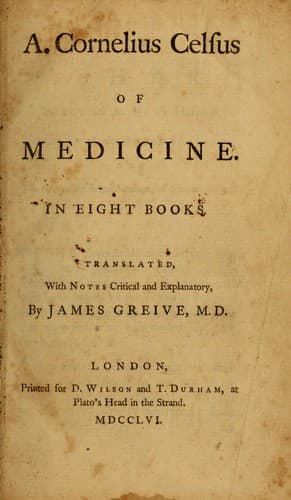
Of Medicine, in Eight BooksCelsus, Aulus Cornelius
History
Of Medicine, in Eight Books
Celsus, Aulus Cornelius
Medicine, Greek and Roman
Now malagmas, and plaisters, and troches, which the Greeks call
trochischi[DN], though in many things they are the same, differ in
this, that malagmas are chiefly made from flowers, and even their
stalks, plaisters and troches are more generally composed of some
metallic ingredients. Then malagmas being beat up are abundantly soft:
for they are applied, where the skin is unbroken: but those things, of
which plaisters and troches are made, are carefully powdered; lest they
hurt wounds, when they are laid on. Betwixt a plaister and a troche
there is this difference, that a plaister admits of something melted:
in a troche there are only dry medicines united by some liquid. Again,
a plaister is made in this manner: The dry medicines are powdered by
themselves: when they are mixed, vinegar is dropped into them, or any
other liquor belonging to the composition, that is not greasy; and they
are again rubbed with that. Those things, that are capable of being
melted, are melted altogether at the fire; and if any oil is to be in
the mixture, it is then poured in. Sometimes too, some one of the dry
ingredients is first boiled with oil. When these things are finished,
which ought to be done separately, the whole is mixed together into one
mass. But the way of making troches is this: The dry medicines being
powdered are formed into one body with a liquor not greasy, such as
wine or vinegar, and again after being brought to a consistence, grow
dry: and when they are to be used, are diluted by a liquor of the same
kind. _There is also a difference in the manner of using these_: for a
plaister is simply applied, a troche is rubbed on, or else mixed with
something softer than itself, or with cerate.
[DN] τροχίσχοι.
CHAP. XVIII.
OF MALAGMAS.
[Sidenote: _1. A cooling malagma for the hot gout._]
These particulars being premised, I shall first subjoin malagmas,
which are commonly contrived not with an intention to cool, but to
heat. There is one however, which is cooling, adapted to the hot gout
in the feet. It contains of galls both unripe, and otherwise, of
coriander-seed, hemlock, poppy-tears, gum, of each an acetabulum, of
washed cerate, which the Greeks call peplumenon[DO], half a pound.
[DO] πεπλυμένον.
The other malagmas are mostly heating. But some of them discuss matter,
others draw it out, which are called epispastica[DP]: most of them are
adapted to particular parts of the body.
[DP] ἐπισπαστικὰ.
[Sidenote: _2. A drawing malagma._]
If matter(35) is to be drawn out, as in a dropsical case, pleurisy,
a beginning abscess, and even a moderate suppuration, that is proper,
which consists of dry resin, nitre, ammoniacum, galbanum, each p. *.
wax, p. *. Or that, which contains rasile verdigrease, frankincense,
each p. ii. *. Sal ammoniac p. vi. *. copper scales, wax, each p. viii.
*. dry resin p. xii. *. and vinegar a cyathus. The same end is obtained
by the meal of cummin-seed with struthium(36) and honey p. ii. *.
Public-domain text, read in full here on John Shaqi.
Reviews
Reviews
No reviews yet
Be the first to share your thoughts on this work.
Elsewhere in the archive
Join the Discussion
Join the discussion
Sign in to leave a comment or review.
Sign InorCreate an account